Sounds: Zaq Kenefick: Funeral Song of the People of the Ruined Cities
If you’ve been going to shows in the last year or so, you’ve probably met Zaq Kenefick. The composer and sax player, who is currently studying at CSU Long Beach, has been coming to and listening to virtually everything in town, a practice that I have a huge amount of respect for. I was listening to some of Zaq’s music last week and came across this miniature that struck me as something very special.
About the piece, which is for mandolin, guitar, and arpeggione (bowed guitar), Zaq says:
Programaticly, the piece takes place in an alternate future where all knowledge about music was lost and had to be relearned. This is the hypothetical indigenous music of those who took shelter in the ruined cities of the past.
This recording is from Ensemble Fret. There’s way, way more music on Zaq’s Soundcloud page, at soundcloud.com/zaqwithaq.
Sounds: Ted Hearne: Law of Mosaics
All week I’ve been listening to A Far Cry‘s recording of Ted Hearne‘s Law of Mosaics. I know I’m late to the game on this one – the piece is from 2012, and wild Up played it in LA a year or two ago – but we never said anything before about it, Ted lives in LA and teaches at USC now, and it’s just a phenomenal piece for strings. Here’s the fourth movement:
The record, which also contains Andrew Norman’s The Companion Guide to Rome, is available from Crier Records here and Amazon here. It’s also on Spotify and iTunes and pretty much everywhere else.
What’s perhaps even more exciting, for those of us so inclined, is that the whole score is posted on Ted’s site at tedhearne.com/PERUSAL_SCORES/LawOfMosaics-FullScore.pdf
In other news, we’re starting up weekly Sounds posts. Check back every Tuesday for a new recording from an LA-based composer or ensemble. See you next week!
Interview: Scott Worthington on Prism

Scott Worthington
This Sunday, ArtShare LA will be hosting a party celebrating Scott Worthington’s recent release of Prism on Populist Records (out August 14, available for pre-order here), a collection of works spanning 2010-present, all in his singular voice. The program will include pieces from the recording as well as other pieces for bass and electronics. We asked him a few questions about the recording and upcoming party:
How did you go about starting work on this set of recordings? You seem to have developed a unique voice with bass playing and electronics. What do you feel is the relationship here? Are the electronics always more fixed and your bass playing more improvisatory? Do they inform each other? What comes first, and how do you craft the pieces?
Back in 2010 I tried to record At Dusk and Prism. That attempt didn’t turn out very well, so I guess you could say that I started to work on it all the way back then. The recordings on the album are from 2014 and 2015. I didn’t craft the pieces in order to produce the album, but I think I got lucky and they sound nice together.
I’m not sure if there’s a relationship. I just try to make electronic parts that don’t sound like my own *very* reductive stereotype of wiz/band/swoosh electronic music. I like some of that music but I’m just not good at making it and/or am too lazy to try.
Neither of the electronic parts on this disc are fixed. In At Dusk, they end up sounding like a very pitchy reverb chamber. It has an entirely notated bass part. I’ve adjusted some of the rhythms and dynamics as I’ve played it more, but I wouldn’t consider is improvisatory. As for the chicken/egg, I had the idea to get the computer to mimic the sustain pedal on the piano, wrote the bass part with that in mind, and experimented writing some different computer programs until I thought it sounded right.
In Reflections I cue the drones in a way that sort of fakes live processing. It has some melodic fragments and ideas that remain the same from performance to performance, but there is no score. This piece started as a bass ensemble work for five basses and I made a version for solo bass and drones afterwards.
Your work seems to prioritize some traditional musical ideas – there are memorable themes and motifs, as well as more atmospheric materials. Are you concerned with making memorable gestures that can be developed? Or do you have a different way of thinking about thematic material?
I guess I’m a “motive guy” or something like that. Sometimes I like to tell people my music is mash up of Brian Eno and Morton Feldman. I like things that can be remembered but aren’t necessarily played the same every time. I think most of the development in my pieces comes from layering different motives on top of each other, but not necessarily developing the motives themselves. Reflections works exactly like this. I have a bank melodic ideas and I put them together during the performance. I used to just write this kind of thing out in score form, but more recently I’ve been eschewing scores and trying to create environments where these kinds of ideas can live and get a bit of a life of their own from performance to performance.
There are two versions of a quintet, with a note, “After Feldman.” While somewhat static, there is still more trajectory here than what I associate with Feldman. Did you have a specific piece in mind that was influential? I’m curious about the reason for two versions – can you describe the compositional method here?
A specific piece, yes! Piece for Four Pianos. Here’s a youtube recording:
I think I have it right that the pianos each have the same part and progress at their own pace. In my piece, there are five separate parts, but I…borrowed…the “at your own pace” bit. Since it’s not exactly the same every time I thought I’d put two performances on the album. I also think they act as nice palette cleansers between the longer pieces on the album.
I really enjoyed Prism. I can see how you’re working with some potent, dramatic materials that are then refracted and explored, like light through a prism. Your handling of the form here seems really intuitive. Did you have a specific structure in mind, or did the materials themselves suggest the form? Is there anything else you’d like listeners to know about the piece?
Glad you enjoyed it 🙂 I think I did have a little structure mapped out (it’s from 2010, so my memory of writing it is a little fuzzy). There are five parts and I think those parts only had to do with the pitches/chords in the sections. I think that was the extent of the formal plan. So, maybe that means it was intuitive? I don’t think I set out with a plan for how long the sections were. It was towards the end of when I was really concerned with pitch sets and things like that and I was (clearly) moving towards using a lot of repetition and being sparse and droney in general.
Your fifth track is in memory of Stefano Scodanibbio. Can you talk a little bit about what his influence is?
He was one of the most incredible bassists (and perhaps musicians) to walk the planet. I never got to meet him or see him perform, but the kinds of things he was capable of on the bass are unparalleled. I wrote the piece shortly after his untimely death from ALS. It doesn’t use any of the techniques or pyrotechnics he was known for and capable of, but I tried to make a contemplative piece in his memory.
Are you excited about the release party concert? Do the other pieces on the program relate to this recording, or are they just pieces you enjoy performing for other reasons?
Yes, I’m excited! I’m also heading off on a CD release tour playing at the Center for New Music in San Francisco on the 14th, the Wayward Music Series in Seattle on the 19th (with Nat Evans), and at the Wandering Goat in Eugene on the 20th (with a lot of other artists and bands). Lots of miles on the car, but I’m looking forward to meeting people and playing some music for them.
I’ll be playing two new works that Nat Evans and Brenna Noonan wrote for me for these concerts. They don’t relate specifically to the album, but I wanted to make a nice concert and not just play the record for people. I met Nat and Brenna through a project that Nat did called The Tortoise (https://natevans.bandcamp.com/album/the-tortoise). The concert will close with Julia Wolfe’s piece Stronghold which is just an awesome piece–it’s kind of a barn burner.
And finally, if you could sit down with your listeners and tell them anything, what would it be?
Hope you enjoy it 🙂
—
We hope you enjoy it too. For more information, visit:
http://artsharela.org/event/scott-worthington-local-cd-release-concert-art-share-l-a/
Scott Worthington – Prism CD Release Party
8.9.15, 8pm, $10
ArtShare
801 E. 4th Place, Los Angeles, CA 90013
See you there!
Review: WasteLAnd Summer Concert Series Finale
On Saturday evening, August 1, 2015, the final concert of the WasteLAnd summer series was given in Clausen Hall at Los Angeles City College in Hollywood. The music consisted of works for piano and voice, with Stephanie Aston, soprano and Leslie Ann Leytham, mezzo-soprano the featured singers. Richard Valitutto and Brendan Nguyen accompanied.
The first piece on the program was Got Lost (2007/2008) by Helmut Lachenmann and this began with whooshing and breathy sounds from Stephanie Aston while a series of low solitary notes issued from the piano, played by Richard Valitutto. This continued for a some minutes but gradually some humming was heard along with a few musical fragments of tunes. This escalated, and rapid runs on the piano keyboard collided with powerfully sustained pitches by Ms. Aston as the dynamic balance shifted back and forth between them. As the piece continued the voice parts became more musical and the piano took on a split personality with Richard Valitutto skilfully executing a number of extended techniques. The piano strings were variously strummed, plucked and stopped by hand as a note was played and this gave rise to a number of interesting effects in quick succession; it actually seemed as if there were two different instruments accompanying the vocals. Perhaps the most intriguing effect was when the piano was silent but with the sustain pedal held down. Ms. Anston gave out a short fortissimo passage that was caught by the piano strings and heard as a ghostly echo. Lachenmann’s unconventional techniques were on full display in this piece – all the more impressive as none involved electronics or amplification of any kind.
Got Lost is without any sort of beat and the performers were seen to be cuing each other as they worked their way through. Their timing and coordination were admirable given the unorthodox demands of the score. The various clicks and pops of the vocal sounds were like a frustrated foreign language, just on edge of intelligibility. The piano added to the alien, anxious feeling with sharp, stabbing notes and loud crashes at unexpected intervals. Got Lost astonishes the listener with its ever-changing series of complex sounds, textures and dynamics and the performance on this occasion was smoothly and skillfully realized.
5 McCallum Songs (2011) by Nicholas Deyoe followed, again featuring Stephanie Aston and Richard Valitutto. This piece consists of five sections, each a setting of the text from the series Love Poems, by poet Clint McCallum. The opening section begins with deep, solemn chords from the piano and the airy soprano voice above singing “I want you to look at me with throbbing eyes…” This sets the tone – plaintive, yet with a smoldering passion. High soprano notes arced gracefully above the piano accompaniment and with the words “I want to show you the cover, and snatch the book away” Richard Valitutto slammed shut the keyboard cover on the piano to end this section.
The second section seemed yet more sorrowful and the quiet vocals had a feeling of lonely sadness about them that hinted at distress. In section three the singing was stronger and more active with soft piano notes and chords underneath. The text “Your begging eyes free my soul, I’ll never let you go” was especially moving. Section four had a single line that was repeated: “to convince you” and this was beautifully sung by Ms. Aston in a small, soft voice. For the final section the piano was tacet and the emotion from the soprano voice singing “ and as I turned you grabbed me and kissed me” was very moving. 5 McCallum Songs filled the spacious hall with a quiet economy of sound yet completely imparted all of the sentiment embedded in the text.
The final piece in the concert was Canti della tenebra (2011) by Swiss-born composer Beat Furrer and this was the US premiere. The featured singer was Leslie Ann Leytham, mezzo-soprano and the pianist was Brendan Nguyen. Canti della tenebra, a setting of text by Dino Campania, was sung entirely in Italian and proceeded in a series of sections. The first began with a deep rumble in the lower registers of the piano that dominated the soft vocals and this established the feeling of faint tension that suffuses throughout the entire work. The voice line soared briefly above, but the piano became more agitated, with notes running rapidly up and down the keyboard. The voice retreated into low, quiet tones, as if subdued, and this added an understated color to the overall texture. Eventually, the piano dropped back a bit as if to give the vocalist some space for a final declarative statement to conclude the opening section.
There were moments that overcame the early bleakness. In a later section, the singing of Ms. Leytham took the lead with a lovely chromatic melody line with the piano in a supporting role. This produced a more introspective feeling, aided by some masterful singing in the lower registers. Still another section had a more uplifting feel as a line of single piano notes was followed by warm, sustained tones in the voice that made for some lovely harmony. The later sections restated the initial sense of anxiety with waves of active piano notes and a series of strong vocal passages filled with tension. Towards the close an extended piano solo moderated the disquiet and the singing became gentle and reassuring. Some very lovely singing and playing followed as the piano slowly faded away at the finish.
Canti della tenebra contains a wide range of emotions that must flow through the voice and piano. The singing of Leslie Ann Leytham – especially in the lower, darker registers – was admirably suited to this task and the playing of Brendan Nguyen provided the ideal accompaniment.
This final concert of the WasteLAnd summer series proved how powerful and evocative the simple combination of voice, piano and poetic text can be in the right artistic hands.
Review: Scott Worthington: Space Administration
WasteLAnd’s third concert in their first summer series continued the theme of meditations on altered time, with a concert devoted entirely to Scott Worthington’s Space Administration. The piece is Worthington’s doctoral dissertation piece, an extended setting of Ken Hunt’s poem, Apollo Spacecraft. The venue was the Velaslavasay Panorama, a community cinema built in 1911 that’s gone through a number of incarnations before its current cozily dilapidated state. The piece shares a number of features with The Cartography of Time, but is most definitely a different beast.
Firstly, the piece includes a video which projects the text of the poem, and provides structure for the hour-long concert experience. The poem itself is an important player in the success of the piece, and deserves careful consideration. The text is taken from NASA’s voice transcription of the first day of the Apollo 11 moon mission, complete with timestamps. Hunt has erased words throughout, however, leaving a skeleton of fragmented phrases, combined and reconsidered through the poet’s lens to form a contemporary ode to Apollo and a meditation on space travel. The poem is quite strong, and even in the fewest phrases, the poet manages to convey convincing vulnerability, will, and longing. It’s to Worthington’s credit that he chose a strong poem to set. Often, poems that are worthy on their own merits can actually be difficult to set, as a powerful text has its own priorities. In this case, however, the absences in the text, as well as Worthington’s thoughtful pace in displaying them, provide enough room for the music’s own dialogue to flower. Here’s an excerpt from the piece:
The piece itself begins with a launch countdown in the video, which is effective in preparing the listener for the relentless march of timestamps that mark the piece. In the previous week’s The Cartography of Time, time stood still. Here, time is inexorably but weightlessly moving forward. Taken individually, the component parts are actually rather simple – samples have been recorded and processed from a Moog in use around the time of the Apollo mission, the green text fades quietly in and out of view, and the contrabass comments on the proceedings with a bank of recurring subjects and themes that bring to mind the frankness and inevitability of a rondo or ritornello. These rudimentary elements combine, however, to create something that does not just hold a listener’s interest, it feels substantial.
What really holds the piece together are the various conceptual tensions throughout. Many of the materials are traditional – recurring themes and motifs that arise with the introduction of key words or ideas, an ode to an ancient god, but these elements are unmoored, floating in a vast space. The poem purports to be about space travel, but there is so much in the imagery that is earthbound, quotidian. There are conflicts in the text between the known that is clung to, and the unknown, which is wholly undifferentiated. There is even a tension between Apollo’s realm – that of ordered music and light, and the occasionally malicious Moog context in which the piece takes place.
When Apollo actually does makes an appearance in the text, he is all of a sudden present. Worthington does an excellent job here at conjuring the sense of an ode in these moments, with variations and intensifications of musical material. We are all trying to communicate with the gods.
The form of the piece is actually somewhat difficult to follow. The form does change, and there are lighter and heavier moments, but transitions feel so inevitable that it’s hard to even keep track of the many locations we’re visiting. This can be a good thing, or a bad thing, depending on the intent of the composer. In this case, being without a goal is quite effective.
Most importantly, the overall effect is not really galactic so much as subjective. We are weightless, but are we really in outer space? The text is so powerful and the setting so passive that the listener’s reflections collapse in on themselves. This is hardly an outward looking conquest of the final frontier. We are definitely looking inward, and upward, with an ancient desire for the heavens.
EDITOR’S NOTE: an interview with Scott Worthington, whose album Prism will be out next week on Populist Records, is on the way too.
Sounds: Nick Vasallo: The Eternal Return
I recently heard that composer Nick Vasallo had moved to southern California, and decided we had to do something on him. I’ve been a fan of his music for a long time, after coming across it via a search for metal influences in classical music a few years back, when he was doing his doctorate at UC Santa Cruz. He’s now here to teach at Cal Poly Pomona, and when I asked what he wanted to put up, he sent me this:
Right?!!
More about the piece is up at nickvasallo.com/the-eternal-return-2015-for-concert-band, and more of Nick’s music at nickvasallo.com.
Introducing Alicia Byer
 Did you read the review of WasteLAnd’s summer series concert with Gnarwhallaby that we posted yesterday? (If not, click here.) It was beautifully written by the newest member of our team, Alicia Byer.
Alicia is a composer/improviser based in Los Angeles, and the Artistic Director of the Caris Collective. She is a fifth-generation Californian and first-generation composer, and her interests include nature, culture, and everything in-between. Alicia is stoked to be writing for us because, in her words, “New music in LA is vibrant, alive, and uniquely Californian. I’m happy to be here for the ride.”
Welcome to the team, Alicia.
Review: WasteLAnd: The Cartography of Time

Gnwarwhallaby at Neighborhood Unitarian Universalist Church. Photo by Tina Tallon.
The inaugural summer series of WasteLAnd is an exciting addition to the innovative concert series – over the span of eight days, four concerts explore facets of WasteLAnd’s aesthetic. Summer casts a more languid hue on concert-going, and WasteLAnd’s thoughtful programming, and aptly named Waste(d)LAnd limited edition beer, seem to take advantage of this seasonal atmosphere.
On Saturday, July 25th, WasteLAnd teamed with the forces of Gnarwhallaby at the Neighborhood Church in Pasadena for the second of these summer performances. The Neighborhood Church has been home to a number of Gnarwhallaby concerts, and it was a refreshing surprise to find that the space had been transformed by the arrangement of the ensemble in the middle of the sanctuary, seats and speakers closely surrounding them, all lit by paper lamps and music stand lights. This subdued atmosphere had a noticeable effect on the experience of these pieces. Visual aspects are often distracting when trying to focus on sound worlds of great detail, and this staging facilitated an un-self-conscious concentration, which is lacking in many audience environments.
The first two pieces, DSCH by Edison Denisov and avance|impulsions mechaniques by Adriana Hölszky, are part of Gnarwhallaby’s standard repertoire, and were executed with characteristic familiarity and care. The pieces were both lovely in their jaggedly taut way, with surprisingly similar languages although separated by a number of decades (1969 to 1997). Both pieces use a vocabulary of ‘classic’ extended techniques, post-tonal, rhetorical gestures, and an abstracted sense of form, but explore different concerns. DSCH is form-driven, with clear demarcations of gesture and response, complex interaction and moments of reflection, while the Hölszky is more unified in its brutality and trajectory, building and exploring a singular kind of momentum with 90’s additive intensity. The experience of these pieces was also made different by the unique arrangement of the ensemble. Contrapuntal sections were clearer and more obviously social, rhythmic interactions more defined and intimate.
The focus of the night, however, was the premiere by composer David Brynjar Franzson, The Cartography of Time, commissioned specifically for Gnarwhallaby.
The commission has been a long time coming. Gnarwhallaby has been in consultation with Franzson since 2012, when the group first heard a piece by the composer at The Industry’s First Take concert. The quartet agreed that Franzson’s piece was their favorite of the evening, and began corresponding with him about writing for the group. In 2013, Franzson came to see the ensemble in New York, as well as in Iceland in 2014. The length of this association is evident in the extraordinarily subtle treatment of the ensemble.
The Cartography of Time begins imperceptibly, with electronic clicks and percussive effects in surrounding speakers gently immersing the audience in the three-dimensional world that is to unfold. Gradually, the ensemble enters with extended, strained tones built from an expertly orchestrated vocabulary of harmonics, multiphonics, and subtly colored intonation. A look at the score shows that the entire piece is organized with exact metrical shifts, and a tempo click heard in a headphone by the cellist who cues the ensemble, but this structural underpinning is completely hidden. Ensemble tones and percussive gestures combine seamlessly with the audio track, building and waning in dynamics from indiscernible to a mezzo-forte at the loudest.
The composite effect is mesmerizing and convincingly organic. Something is definitely living and breathing – if not a human being, then the landscape itself swells. The bass clarinet seems to lead in many areas, even if this is unintended, as its versatility allows for a range of expression that naturally contrasts with the other parts. From impossibly strained high tones, blending with the electronics, to low growls and multiphonics at the bottom of the range, the bass clarinet provides a frame and impetus for the rest of the ensemble. Muted trombone swells are insistent, but self-possessed. The piano is used economically, in a percussive manner. Franzson carefully chooses to forgo the enormous gestural capabilities of the piano. No cliché registral leaps are in evidence here: sharp attacks on single tones with subsequent ringing or damped harmonics fit beautifully into the texture. Cello tones are somehow simultaneously woody and glassy and blend imperceptibly with the electronics. Gnarwhallaby is at its best here; the execution was precise, integrated, and beautiful.

Gnwarwhallaby at Neighborhood Unitarian Universalist Church. Photo by Tina Tallon.
Rather than building from this texture or jostling the listener in another direction, however, Franzson remains in this temporality for the entirety of the thirty-or-so minute piece. Where other composers may have easily been tempted to exploit the materials here, quickening the pace, or exploring all electronic possibilities, Franzson’s approach is more receptive, and decisively so. The remarkable restraint here is by far the strongest feature of the piece; by focusing on a single experience of temporality, Franzson truly creates an altered sense of time, rather than simply the idea of one.
Many works of this scale and intent miss this crucial distinction. When a sense of immersive, suspended time is attempted, audiences are too often left adrift. A composer can easily disregard the natural ebb and flow of attention, demands on the listener are too great for the aesthetic reward, or the suspension of expectations in a piece breaks down, forcing attention elsewhere.
Here, Franzson has displayed the true craft of the composer – informed attenuation of the audience’s attention. The organicism and looseness of the landscape allows for real fluctuations of audience attention and perception, without dogmatic demands or meretricious ploys for listener interest. A glance around the room showed evidence of this skill: the energy in the room had dropped, people’s breathing had slowed, many had eyes closed and almost all wore contemplative expressions.
Rather than a first effort, Cartography is obviously the work of a composer experienced in creating this particular experience of time. Ironically, the title The Cartography of Time seems a bit misleading – cartography is the detailed cataloguing of uncharted territory, but in this piece, we have already arrived. We know exactly where we are, planted firmly in a single temporality in which gray, smoky landscapes seem to come in and out of focus, approach and recede around us. The world we inhabit is not the two-dimensional world evoked by maps, however allegorically intended, but a very real and vibrant three-dimensional world, crafted by an extraordinarily capable composer.
Review: KinoEar at the wulf
On Friday July 3, 2015 the wulf featured a presentation by KinoEar, a collaboration between composer Ma’ayan Tsadka and visual media artist Danielle Williamson. A surprisingly ample holiday-weekend crowd turned out to witness the video documentation of a fascinating series of found instruments, their associated sounds and the relationship they have to their physical surroundings.
The first video was made at the McHenry Library at UC Santa Cruz, on the outside stair case. This stairway is made completely of steel and has railing posts about 6 inches apart. A large wooden stick from a nearby tree was used to strike each of the railing posts in passing as a person walked down several flights. This generated a series of wonderfully booming tones – almost bell-like in timbre, yet unmistakeably metallic and mundane at the same time. The video reinforced the image of a utilitarian stairwell, but the sounds were often musical. The pitch seemed to lower somewhat as the bottom levels of the stairs were reached and the sound receded into the distance. At other times a rapid trilling was achieved by moving the stick rapidly back and forth between two railing posts. At one point the entire steel staircase was struck, generating great resonant thunderclaps. All of this was captured with a boom microphone, field recorder and simple video camera. The intriguing part is that your brain has to determine what sounds are musical and bell-like and what is simply metallic noise. The tones and video cross back and forth over this boundary and the listener is constantly evaluating the images and the sounds.
The next video sequence featured rocks being thrown at a steel drainage grate in the middle of a field. When a rock struck, a bright chiming sound was heard – like being inside a small clockwork striking the hour. The tones and length of reverberation varied, and eventually a person was seen striking the grate repeatedly with a rock, generating different volume levels depending on the force. Finally, a rock was dragged over the entire grate, creating a rapid clatter of chimes that was very musical. The visual presence of the utilitarian grate in the middle of the field belied the brilliance of its sound and this made for an interesting contrast.
A third video showed a tube emerging from a cement casing and the open end was struck with a wooden stick. Several video images of this were shown simultaneously and this gave a sort of rhythm to the sequence. The sounds were not bright or even metallic, but rather a light glassy clanking that echoed down the tube and returned again with a characteristic thump.
There was also a series of videos made at Yosemite and in the first of these the sights and sounds of traffic roaring through a darkened tunnel proved both powerful and frightening. The camera then follows a side tunnel and all is serene until the end is reached, revealing a spectacular view of the valley below. Another sequence featured rocks thrown into Chilnualna Creek and these landed in the water with a series of satisfying splashes of varying pitch and character. Anyone who has done this as a child will sense the nostalgia that this evokes and mentally calculate the size of the rock from its splash.
Another Yosemite location centered on a large stair railing, and when this was struck it gave off a chime big enough for a cathedral bell. Other parts of the railing gave off higher and lighter pitches and birds could be heard squawking in the background This was done at dawn with a video image of Half Dome looming above – an almost church-like setting – and a definite zen sensibility. In the final sequence a large tree was struck in various places on its trunk and this produced, variously, a full, booming resonance or a lighter clicking sound depending on where the blow was struck. Three images and sounds were combined and this brought to mind a sort of primal drumming.
Like the music of Pauline Oliveros, KinoEar has captured sounds that have two simultaneous contexts and it is left to the listener’s brain to separate the musical from the prosaic. These KinoEar videos are a thoughtful exploration into the relationship between images, music and acoustics.
Several of the KinoEar videos are available here.
Review: Become River at Ojai Music Festival
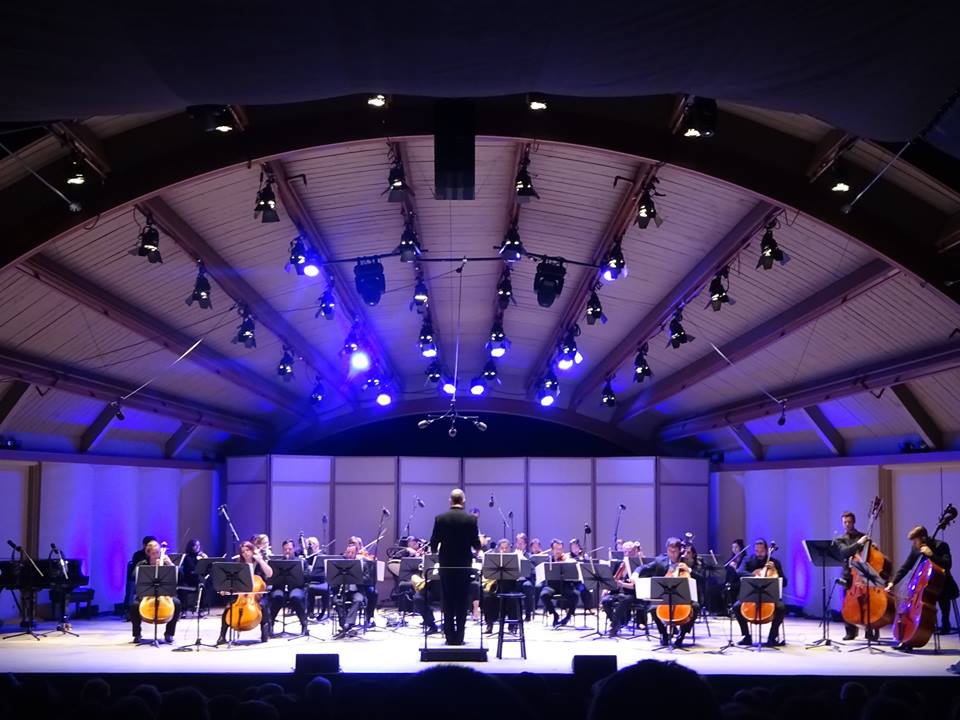
Photo by Bonnie Wright (used with permission).
The 69th Ojai Music Festival continued late Saturday night, June 13, 2015, with the West Coast premiere of Become River by John Luther Adams as performed by ICE and Renga and conducted by Steven Schick. The Libby Bowl was filled for the 10:30 PM starting time with an energetic crowd on hand to hear two pieces, capping off the third full day of the festival.
Become River begins with an almost inaudibly high, thin pitch from bowed percussion that gradually builds in volume. The violins join in, playing their highest notes and starting a repeating phrase that is doubled by light bell-like sounds. One can almost imagine a small rivulet forming in a high meadow, winding its way down hill joining with others as it heads toward the sea. The flutes enter, adding volume and body to the small stream of sound, and with the clarinet entrance there is a markedly substantial feel. The orchestration in this performance was larger than, say, a chamber group, but smaller than a standard symphony – each of the horn, string, woodwind and percussion sections were represented, but in modest proportions.
Each succeeding entrance added to the harmonic richness, and the sound grew in volume and density with the repeating phrases gathering momentum. The beat was straightforward and the tempo relaxed but purposeful. Midway through, a certain amount of syncopation could be heard in the phrasing and this effectively served to shape the texture of the sound so that it very much resembled a flowing river – always full of motion, running waves and swells. As the trumpets and low brass entered, a noticeable sense of power was added and by the time the lower strings were heard there was a full, majestic feeling in the sound that nicely evoked the image of a large river approaching the sea. There was never any sense of anger or menace in this strength, however. Typical of Adam’s treatment of nature, there was a sense of peacefulness and cordial calm, an appropriate reminder that we would do best to live in harmony with a welcoming earth. As the piece concluded – and it seemed all too short – there was enthusiastic applause from the audience as John Luther Adams, Steven Schick and the musicians took their bows. Along with Become Ocean, Become River is now the second in a series of milestone works by John Luther Adams on the relationship of nature to humanity.
The second piece of the evening was the iconic Appalachian Spring by Aaron Copland, commissioned in 1942 by Martha Graham as a ballet and subsequently arranged in 1945 as an orchestral suite. Most listeners are familiar with the muscular symphonic adaptation of this piece, but for this performance The International Contemporary Ensemble played the lesser known the chamber orchestra version consisting of a double string quartet, string bass, flute, clarinet, bassoon and piano. This proved to be a revelation – the themes, harmonies and delicate structures of this piece came through with an amazing transparency, precisely preserving all the subtle details that are often swallowed up in the full symphonic version. The playing could not have been better – the ensemble was very tight, carefully balanced and pitch perfect in the cool night air. The woodwinds especially stood out, carefully crafting the quiet motifs and playing together seamlessly. The Libby Bowl sound system contributed as well – all of the subtleties and nuances in the playing were faithfully preserved. Those who stayed late to listen to Appalachian Spring were rewarded with luminous performance and a beautiful new way to understand Copland’s classic of American music.
Kate Hatmaker, violin, also appeared with ICE on Appalachian Spring.