An Interview with Composer Karl Kohn
Karl Kohn is highly respected as a composer and pianist, not just in Los Angeles but also throughout the world. He’s also had a long career both as a teacher and on the board of directors of Monday Evening Concerts. In light of the upcoming Piano Spheres concert (this coming Tuesday, November 7), where Mark Robson will be playing a solo piano work by Kohn (Seven Brevities), I had the opportunity to ask him some questions about composing, his long performance career as a pianist, Monday Evening Concerts, and more. Here’s what he had to say:
Having served for two decades on the board of directors for Monday Evening Concerts, could you tell us about your experience there? Do any particular memories stand out?
The connection with MEC was very important for my wife Margaret and me. Under Lawrence Morton’s directorship the concerts were an opportunity to hear and to perform old repertoire as well as many new works, both by contemporary American and by European composers. Our collaborations and friendship with Pierre Boulez was special and delightful, but the list of other wonderful and meaningful composers and musicians with whom we worked is very lengthy.

Composer Karl Kohn
Has your childhood growing up in Vienna informed the type of music you like to play/write? How so?
I was brought up in the Viennese Classics but also played some Debussy and Ravel. It was not until the years at Harvard that I played my first piece of twentieth-century music, Hindemith’s Third Piano Sonata. My freshman advisor at Harvard, Edward Ballantine, sent me packages of music while I served in the Army on Tinian in the Marianas, shipments that included works by Scriabin, Stravinsky, and the last two volumes of Bartok’s Mikrokosmos. I was a lucky guy.
You’ve composed for a wide range of instrumentations/genres of concert music. Do you have a favorite instrumentation/genre that you like to write for? Least favorite?
I have no favorites, either in the instrumentations/genres, and no favorites, really, among the works that I have composed – I like “all my children!”
Having written extensively for orchestra, what are your thoughts about composing for this medium? Has your opinion changed over time?
I loved writing for orchestra, and also for symphonic band. But for a Los Angeles-area composer (and especially a reasonably shy one situated way out in Claremont) writing for orchestra is not rich in opportunities. Nevertheless I have written several large orchestral works and all have had performances. In recent years, however, I have written and continue to write mostly for smallish chamber combinations of instruments.
How has your performance career as a pianist informed your career as a composer, and vice versa?
I imagine that my career as a pianist has had a very powerful impact on my compositional career, and I have written very much music for the piano, both solo and duo, and also for chamber groups that include the piano.
Your wife Margaret also has a long career as a pianist, and the two of you have performed together as a duo across the world. How do you inspire/encourage each other? What has your career of performing together been like?
Margaret and I started performing together while we were undergraduates at Harvard, almost seventy years ago – wow! For me certainly it has been a great joy to rehearse and play together with her these many years – indeed a blessed life.

Karl Kohn and his wife, Margaret.
Along with composing, you’ve also had a long career as a teacher. What are your thoughts about teaching? Do you find that it changes the way you look at music?
I taught at Pomona College for 44 years and have been retired from teaching since 1994. I like to think that it was a mutually beneficial experience both for my students and me.
You’re known for having a unique voice as a composer, which links an innovative musical style with a deep understanding of European classical tradition. How did your voice as a composer evolve? Where do you find the main sources of your inspiration?
As for my voice as a composer: I was brought up at Harvard in the milieu of American neo-classicism, admiring the music of my teachers Irving Fine, Walter Piston, Randall Thompson, and also Aaron Copland at Tanglewood. The Monday Evening Concerts and three sabbatical years in Europe gave me an opportunity to stay abreast of current developments from mostly in Europe while at the same time retaining my feet on the ground with teaching – albeit wonderful but more or less initially “unwashed” – undergraduates at Pomona College. I consider that my “style” since the late 1960’s has been referential to the broad historic past of Western, i.e. European and American, art music.
What advice do you have for emerging composers?
Get to know as much music of the past and present as possible, but be aware that this is getting to be ever more difficult in our current musical world. There is no any longer just one musical heritage but rather, in the words of David Noon, a former student: we live now in “a condominium of Babel!”
Check out Piano Spheres for more information on the upcoming concert, Tuesday November 7.
Jack Curtis Dubowsky Ensemble and The Phantom Carriage
It was the night before Halloween, and the stage was set – the anticipation of a ghoulish silent horror film from the 1920s, a vintage theater full of charm, audience members in costume, even the pianist was dressed as the Grim Reaper. It was my first time at the Art Theater in Long Beach, a place I’ve been wanting to visit for some time. (I absolutely loved the venue. Anyone in Long Beach, go there now.)
In fact, it was a night of firsts for me, since it was also my first time seeing a silent film with live music. I was immediately struck by the pacing of the film – I found myself all-too-aware that I’ve become numb to absurdly fast-paced media. As such, it was refreshing to be able to sit back and enjoy the slower action of The Phantom Carriage. The pacing was in no way a reflection of the depth of the film, which seemed to be well ahead of its time. In fact, the unfolding of events allowed for layers of subtlety that a faster-paced film could not have achieved. Special effects abounded (ghosts walking through doors, etc.), flashbacks on flashbacks, plot twists…this film had it all, and a classic tale of morality to boot.
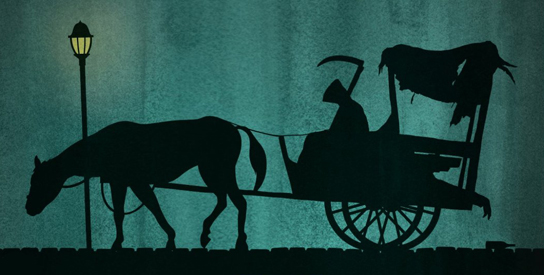
Needless to say, I didn’t just come to see this classic film – I also came to see the reimagined score by the Jack Curtis Dubowsky Ensemble. The composer, Dubowsky, was also the conductor of the ensemble, which was comprised of Charles Sharp on bass clarinet/flute, Henry Webster on viola, Slam Nobles on percussion, Jeff Schwartz on double bass, and R. Scott Dibble on keyboard and electronics. The score was full of musical imagery, from cymbal swells to represent waves, flouncy flute lines as women laughing and bass clarinet riffs for men laughing. There was also a fair amount of mickey-mousing, such as the tick tock of a horse walking, ensemble members talking with hands over their mouths to represent the muffled chatter of the crowd in the picture, to drum hits as literal smacks and falls of the characters onscreen.
The music itself was mostly tonal, with a handful of themes that played through most of the film. These themes sounded traditional, often patriotic, meant to reflect the time period and the innocence of many of the characters on screen. Along with the conventional harmony implied with these melodies, there was an undertone of a more abstract, experimental score that could emerge at any moment, which perhaps was meant to represent an underlying evil. At the times when this part of the score did emerge, it was usually when something supernatural was happening onscreen. My favorite moments were these moments of abstraction – it was here that I felt the underlying character of the film was more present.
Instruments also became representations of character’s actions. For example, as a character onscreen shrugged off the command of someone, a bass clarinet line approached the scene with similar attitude. For the most part, I got the impression that the bass clarinet took on an emotive role, rather than portraying specific action. By contrast, the percussion largely seemed to reflect specific actions on screen, which is helpful when the film itself has no sound embedded within itself. Electronics played a subtle role throughout the score – mainly, they acted as a quiet force in the background, waiting to emerge.
Overall, the whole experience was a lot of fun. (And slightly spooky.)
Nicholas Deyoe, “for Duane”
 On October 20th Populist Records—a Los Angeles label dedicated to local experimental music—released two new albums: Nicholas Deyoe’s “for Duane” and Ashley Walters’ Sweet Anxiety (review of Walters’s album is forthcoming). The day after moving to Los Angeles, I abandoned the assembly of Ikea furniture for the double-release show at Thymele Arts, complete with vegan cupcakes and custom beers from Solarc Brewing. But if the familiar faces, cozy venue and homegrown accoutrements rang more of a trendy Thanksgiving dinner than a classical concert, it certainly wasn’t for lack of musical substance: Selections from the albums were performed with a virtuosity and commitment that commandeered my sugar-high into a full case of gotta-get-home-and-listen-to-this. And so, surrounded by mockingly-tiny allen wrenches and indecipherable assembly instructions, I enter the violent and delicate sound world of Deyoe’s “for Duane”.
In talking about his music, Deyoe emphasizes how building friendship, collaboration and trust with his performers has informed his work since arriving in California a decade ago. “for Duane” is an album born of these relationships, marked by detailed instrumental writing and performances saturated with musical intention. Deyoe’s sound world is one of seeming contradictions; bold yet nuanced, violent but fragile. Throughout the album there is a dialectic between body and mind, pitting raw physicality against moments of distilled clarity and introspection. But behind these dramatic shifts in affect is always music that shimmers with complexity, keeping the listener suspended in the neurotic, intricate atmosphere that pervades this album. If one thing in particular stands out on first listen, it is that this atmosphere is inhabited by the performers with such conviction and vulnerability that many moments feel intimate—even voyeuristic—to listen to. But with each subsequent listen the uncompromising degree of creativity and care afforded every moment becomes clear.
The album opens with Finally, the cylindrical voids tapping along, commissioned by the LA Phil and premiered by wasteLAnd at the 2016 Noon to Midnight festival. Six songs and an interlude for soprano, flute, trombone, cello and double bass, set to a text by Allison Carter, comprise the piece. A work of outrageous expressive agility, it functions well as an introduction to Deyoe’s musical language: the composer weaves Carter’s text into an ensemble impassioned with frenetic, nervous energy and punctuated by inescapable, foreboding stasis. A formidable palette of noises are summoned from the trombone, combining with the low strings to create heavy, thick textures whose surface twinkle with flute, sometimes appearing suddenly, other times emerging from the background. Soprano Stephanie Aston masterfully navigates these transformations of character, and the pacing of each textural change feels natural and carries a sense of inevitability before yielding finally to the work’s sinking, moaning conclusion.
1560 is a relentlessly energetic three-movement work for violin and viola. Written for and performed by Adrianne Pope and Linnea Powell of Aperture Duo, the resulting sound is much bigger than its parts. The crispness of their unison playing gives the moments of departure the impression of an object coming apart at the seams as it spirals wildly (which is likely heightened in a live performance by Deyoe’s instructions for the changing physical positions of the players). Here, too, the timing proves fundamental to the work’s success, building to one final, screaming, bow-heavy stand before dying away to the whispering harmonics that end the piece.
The next two pieces on the album are both solo works. Lied/Lied was written for speaking/singing violinist Batya MacAdam-Somer using fragments of her own text. It is a modular work of twelve parts, which can be combined and varied in a number of ways, and on the album MacAdam-Somer brings great wit to her performance of this conversational, sometimes light-hearted collection. But where the playful moments of Lied/Lied bounce around the room like banter among friends, Immer wieder offers a sobering, reflective alternative to solo work. Stephanie Aston performs this second solo piece with a patience that aptly highlights Rilke’s superimposition of love and fate. Deyoe inflects the vocal writing with microtonal shadings that amplify his use of extreme registers, adding a haunting ethereal quality to the soaring high notes and an emotive, human quality to the lows. Taken together, the solos are a brief respite from the dense, imagined soundscapes of the earlier works, instead offering protagonist-driven performances of more personal and relatable impetus.
The album closes with a considerable, two-movement work, Lullaby 6 – “for Duane”, dedicated to Deyoe’s father who passed away last year. The first movement functions mostly like a chamber concerto for cello, and Ashley Walters’s playing embodies the love, tension and conflict of the piece with astounding musicianship and sensitivity. The gestural cello writing awakens lush backgrounds—sometimes aggressive timbral blocks, other times intricate, animated whisperings—carefully balanced in their counterpoint of fore-and background in a way reminiscent of Berio’s writing. The ensemble’s playing is chaotic and precise, creating a sense of urgency as it evolves into raucous, tutti, walls of sound. Suddenly, though, the intensity recedes into a quiet choir of voices, a distant resonance of the preceding brutality. Given this space, the cello comes to the lead once more, only in this second movement it finds itself fruitless in arousing the once anxious ensemble. Instead, the cello is itself absorbed into the quiet murmurs of the background, slowly and gradually. As the other instruments disappear completely and the cello begins to dissipate into the atmosphere, Deyoe offers one final, grounding gesture—a quiet, open strike of the lowest cello string, which vibrates freely for just a moment before it, too, is silenced for good.
Overall, the album “for Duane” is a testament to the creative potential born out of serious collaboration between composer and performer. Deyoe’s fiercely intelligent writing articulates a musical voice both bold and sensitive. Brought to life by the excellent performances of the musicians, this album truly hits you in the chest with its raw physicality before re-crossing its legs and asking you sweetly over rimmed glasses, “… and how does that make you feel?”
Well make of it what you will, but it makes me feel good, Populist Records. It makes me feel really, really good.
An Evening of Song Cycles in Glendale
Mezzo-soprano Megan Ihnen and pianist Nadia Shpachenko performed original works by George Gianopoulos, Yuri Ishchenko, and Christian Carey, as well as a solo vocal piece by John Cage, at a new music recital titled The Truth in Simple Things at St. Mark’s Episcopal Church in Glendale on Saturday. The weekend audience made its way into the cavernous sanctuary of St. Mark’s and settled comfortably into the long wooden pews.
Based on the poetry of Edna St. Vincent Millay, Three Songs of Shattering for Mezzo-Soprano and Piano, Op. 18 (2009/2013) by George N. Gianopoulos opened the program. The first movement, No. 1: The First Rose…, began with a haunting piano phrase and a strong vocal entrance by Ms. Ihnen that filled the large sanctuary space. There is a somber feeling in this music, aided by a trace of the blues in the piano accompaniment. Ms. Ihnen’s rich mezzo voice was powerful enough to be heard everywhere in the audience without a microphone or amplification – but the spaciously resonant hall tended to swallow up the words of the text. Even so, the smoothly strong vocal lines, offset by Ms. Shpachenko’s active piano passages, produced a finely balanced combination.
The brighter, jazzy feel of No. 2: Let the Little Birds Sing… included some lovely vocals in a high register that went soaring lightly over the piano line. Expressive and playful, this movement prompted a spontaneous round of applause as it concluded. No. 3: All the Dogwood Blossoms… began with powerfully dramatic chords in the piano and tightly drawn vocal phrasing that dialed up the tension. Forceful singing, blending nicely with an intricate piano accompaniment, went weaving in and out of the texture, adding some drama. A powerful crescendo from both performers filled up the hall and then pulled back slightly, enhancing the strong finish. The audience greeted Three Songs of Shattering with sustained applause.
A second Gianopoulos song cycle, this one based on the poetry of Sara Teasdale, followed. I. Dawn, the first movement of City Vignettes for Mezzo-Soprano and Guitar (or Piano) Op. 29 (2013), began with a solemn vocal line and a bustling piano accompaniment, similar in character to the first Gianopoulos piece. Strong, declarative lyrics followed, with further flourishes in the piano as if the rising sun were still over the horizon, a power more sensed than felt. A more relaxed II. Dusk featured an overarching vocal melody that soared smoothly upward, filling the big sanctuary space with sound. Ms. Ihnen’s power and range were on full display here and quite effective. III. Rain at Night gave a more cautious and tentative feel, especially in the piano, while nicely shaped vocal phrasings added to a sense of uncertainty. This movement captures the generally mixed feelings Southern Californians have about rain at night – especially on the freeways. City Vignettes for Mezzo-Soprano and Guitar (or Piano) further validates Gianopoulos’ pragmatic style of assigning technical embellishments to the piano, freeing Ms. Ihnen’s robust voice to rise impressively upwards, filling the space above the audience.
Piano Sonata No. 6 (2005), by Yuri Ishchenko began with a Fantasia. Its strong opening and quietly mysterious melody made for a gloomy feeling. A bit of agitation animated the texture, leading up to a series of resounding chords. This pattern of quiet tension followed by increasingly anxious passages continued, especially in the lower registers where deep rumblings added a sense of menace. A marvelous Ukranian bleakness poured grimly out of the keyboard under Ms. Shpachenko’s steady hands. The dynamics and tempo increased just as the texture thickened, the notes rushing out into the audience like a dark, flowing torrent. A very rapid run upward and a solemnly quiet chord at the finish carried Fantasia to its conclusion.
The second movement, Imperativo, arrived with a bright, almost waltz-like tempo invoking a feeling that is both decisive and purposeful. The active phrasing, while often complex, never felt timid or nervous. The precise and nuanced playing impressed, especially in the quieter stretches, and a hint of Prokofiev lyricism emerged in the melodies. A new line in the lower register rose up in a complex wave, making its way through the middle piano keys and accelerated to an almost fugue-like intricacy. This is engaging music, aided by the expressive passages and a profusion of notes that roared outward at the conclusion. The final movement, Epilogo, proved much more subdued, with tentative notes and a vague feeling of uncertainty. Although brief and fittingly restrained, this movement contrasted perfectly with the preceding fireworks. As the last notes died away, much cheering and applause arose for this most energetic performance
Aria by John Cage followed, a solo piece for voice. Ms. Ihnen explained that the score is fashioned from graphical notation with symbols, shapes and colors employed to indicate the vocal line. Aria began quietly, with a combination of musical notes and vocalese. Various languages comprised the text, the words mixing with sharp, spiky sounds and smoothly soaring musical notes. Hand clapping and breathy sounds scattered among the musical tones added to the variety. The dynamics and tempo frequently changed, often without notice, but skillful execution by Ms. Ihnen made for a graceful flow. The constant need to fit the various sound fragments into some sort of context proved challenging, and the sequences came as from a dream. Aria follows the philosophy of other Cage pieces – music is present everything we hear, as part of a continuous spectrum of sound experience.
Kenyon Songs, by Christian Carey followed, three pieces based on the poetry of Jane Kenyon and completed between 2007 and 2009. Song opened with soft chords and a simple melody in the piano. A settled, nostalgic feeling came through and the quiet lyrics spoke of the familiar and the mundane: “An oriole sings from the hedge, and in the hotel kitchen the chef sweetens cream for the pastries…” Subdued and straightforward phrasing in the vocals sustained a pleasant wistfulness. A bit of tension crept in as the lyrics turned to some threatening weather: “Far off lightening and thunder agree to join us for a few days down in the valley…” The vocals became stronger, but never evoked even a hint of menace in this charmingly peaceful portrait. Next was Otherwise, and the smoothly graceful opening extended the sense of serenity. Homespun lyrics persisted: “I ate cereal, sweet milk, flawless peach, it might have been otherwise” – that last phrase introducing just the slightest uncertainty, echoed in the piano line. More singing of benign, everyday activities followed, each phrase ending with “…it might have been otherwise.” The final line: “But one day I know it will be otherwise.” forcefully drove home the point of the poem. The carefully modulated vocals and accompaniment perfectly matched the intentions in the text. As Otherwise concluded the feeling turned poignant, reflecting the sense of impending loss.
Let Evening Come completed Carey’s song cycle. This brought a warmer feeling combined with a sense of completion – a welcome to the end of the day. The declarative phrasing in the voice added a bit of purpose, echoed from the text “To the bottle in the ditch, to the scoop in the oats. to the air in the lung – let evening come.” Kenyon Songs celebrates those small, prosaic parts of life that so often bring great contentment; the music and the nuanced performances capturing this exactly.
The final piece on the program was Three Songs for [Mezzo] Soprano & Piano, Op. 7 (2007/2010) – another song cycle by Gianopoulos. Based on texts by Dorothy Parker this consisted of three sections: I. Little Words, II. One Perfect Rose and III. Purposely Ungrammatical Love Song. A breezy, Manhattan feel that combines the wit and energy of Ms. Parker’s prose with a Broadway sensibility permeates all these pieces. The carefully balanced piano and vocal passages occasionally contained some impressive flash from the keyboard. The final section featured a nicely syncopated melody in the vocals joined with a light, swinging feel that animates the accompaniment. Three Songs for [Mezzo] Soprano & Piano perfectly expresses the elegant urban sophistication of New York at its height.
Interview: Lyris Quartet
Tonight, soprano Elissa Johnston will join the Lyris Quartet at Monk Space for what’s sure to be a beautiful night of music. In anticipation of the quickly approaching concert, I had the opportunity to interview Lyris Quartet members Alyssa Park (violin), Shalini Vijayan (violin), and Luke Maurer (viola) about the program, thoughts on collaboration, and more. Here’s what they said:
The program contains a set of lyrical, moving, and experimental works from a variety of composers, including Arvo Pärt, Pin Hsin Lin, John Tavener, David Hertzberg, and Evan Beigel. From a programming perspective, how do the pieces relate to each other, and/or how do they contrast?
Perhaps the unity of the concept for this program lies in the reflective and complex writings of each composer. Each of these pieces have their own unique meditative quality which is not to say that they lack power. On the contrary, because of the subtleties and contrasts within each piece, it creates a haunting beauty. We hope this selection of composers and their pieces will help the listener look inward and be able to escape all the chaos around us…to be in the moment and just feel. (Alyssa)

Lyris Quartet members Alyssa Park, Shalini Vijayan, Luke Maurer, and Timothy Loo.
How often do you perform with vocalists? What has the process of collaborating with soprano Elissa Johnston been like?
We’ve had the opportunity to work with vocalists in a number of different settings. As the featured string quartet on Long Beach Opera’s production of David Lang’s The Difficulty of Crossing a Field several seasons ago, we had the rare chance to support an entire cast of vocalists. That said, when we get the chance to work with a singer in an intimate setting such as this, it is always a special treat. The beauty of the voice is the ideal to which all instrumentalists aspire, in phrasing, tone and timbre. Elissa is always such a joy to work with because she can grasp such a wide array of styles with her captivating voice. Not to mention, that she is a fabulous person and really fun to be around! (Shalini)
Both you and Elissa Johnston are known for performing a wide variety of works, both from the classical canon as well as living composers. Has this repertoire informed your playing in any ways you’d be interested in sharing?
We do have a great foundation of having played many of the celebrated works for quartet together, and it’s always great to revisit pieces from past eras after working on those from this century. We are fortunate to often have the chance to work directly with composers on new music for quartet. Indeed, three of the pieces on Tuesday’s program are by composers right here in Los Angeles! Years of collaboration with many composers definitely has expanded our own individual instrumental technique, and it has built up our ability as a group to listen and react to each other. (Luke)
For more information about the concert or to get tickets, check out Tuesdays at Monk Space.
Ashley Walters and Nicholas Deyoe on their history as collaborators
Composer Nicholas Deyoe and cellist Ashley Walters celebrate the release of their albums for Duane and Another Anxiety on October 20th, 2017 on Populist Records.


Each album has a distinct narrative, but the two releases are connected — two of Deyoe’s works appear on Walters’ album and Walters appears as both a member of the WasteLAnd ensemble and as a soloist on for Duane.
For this interview, Nick and Ashley reminisced about their collaboration over the past decade. Here, they present stories about their albums, music, and friendship.
First Impressions of Each Other
ND: I first met Ashley Walters in rehearsals for my second jury piece at UCSD (September-ish 2007), but I’d seen her perform with the Formalist Quartet a few times in the year before that. She was really astonishing in the quartet performances that I’d seen and I was really excited to get to work with her. She was detail-oriented, clear and direct in her feedback, and unbelievably positive. When we met, I was still really figuring myself out musically. I had a lot of insecurities that I was desperate to keep hidden and regularly felt like I wasn’t making music that was as interesting as that of my colleagues. Ashley was someone whose support and enthusiasm for my music made an incalculable difference in how I saw myself. As I became more confident in myself and my music, I began to feel much more free to develop my language (I’m not sure I’ve ever expressed these sentiments to Ashley). Daniel Tacke (who wrote a beautiful essay for my liner notes) and Stephanie Aston were two others who played pivotal roles for me. These were people who helped me question my work in a constructive way, helping me understand who I wanted to be musically.
AW: I met Nicholas Deyoe when we were grad students and neighbors in San Diego. I immediately noticed Nick’s presence and energy in rehearsals — he was professional yet sensitive; gregarious yet humble. I found tremendous energy and extreme contrasts in his music, which has biting, severe, and brutal sounds with moments of purity and sweetness. Whether I think of Nick in those early meetings or as a current collaborator and friend the word that always comes to mind to describe him is kind. He is a prominent force in the LA music scene not only because of his professional drive but because our community knows that he is invested in making connections with people and building strong friendships. I think there are many people who would consider themselves lucky to have met Nick.

Cellist Ashley Walters and composer Nicholas Deyoe. Photo by Warren LaFever.
ND: After this, Ashley and I started working together a lot, especially once we discovered that we were neighbors. Hearing Ashley’s perspectives on working with other composers, rehearsal preparation, and performance materials shaped my own approaches toward all things. I had the luxury of not only learning from her through our collaborations, but by drinking tea and talking about issues in other music, teaching, and life. She is thoughtful, direct, and never negative without warrant. If Ashley thought something was a problem, there was a good reason. She was the person to teach me that cello music is just as much about the person holding the instrument as the instrument itself (seems silly to make such an obvious statement) and that not all cellists have massive hands. She also demonstrated time and again that she would always strive to find a good solution for anything. Her dedication is remarkable and is something I witnessed immediately. In the 10 years we’ve known each other, I’ve only watched that dedication to her craft, her community, and her students deepen.
AW: Our first collaboration, For Stephanie (on our wedding day), was written for a momentous occasion — the marriage of Nick and Stephanie Aston. I am still touched to this day that our first collaboration was presented at such a personal event for two dear friends. During the process of creating this piece we spent as much time drinking tea and building our friendship through conversation as we did experimenting with sounds. This allowed us to connect first as friends and artists and then as collaborators not long after. [There is a work on each of our albums that was written for and performed at each other’s wedding. Six years after Ashley performed For Stephanie at my wedding, Stephanie performed Immer Wieder, which was composed for Ashley’s marriage to Luke Storm.—ND]
Then and Now
AW: In some ways it is impossible for me to imagine my career without the presence of Nick Deyoe — both as a colleague and as a composer. Releasing these two albums on the same day feels like the perfect celebration of a chapter in my life that has been enhanced by our work together.
As a performer, I try to be a portal between a composer’s voice and the audience’s experience. It has been a true honor that Nick has chosen me time and time again to be his ambassador of sound. Nick has challenged my technique and my own creativity; his music constantly inspires me to explore new colors and timbres on my instrument. I am a better cellist because of our work together. Nick’s musical language is unique but now feels completely familiar and comfortable to me. It’s like riding a bike — but his music is much more difficult than that!
ND: My relationship to pieces like another anxiety or for Stephanie are a lot different now than when I composed them four and eight years ago. At the time of creation, I was very focused on every detail, fussing over the sculpting of small moments. Now, as Ashley plays the pieces over and over again, across several years, I’m continually excited by the way she surprises me. At this point, I assume the time she has spent practicing the pieces surpasses the time I spent composing them. She has put incredible thought into every moment of the interpretation. She owns these pieces now, and it is an honor to watch her thought process unfold. In our early meetings refining her part for Lullaby 6, it felt like I was hearing her play an old piece. Ashley’s earliest interpretations were already nuanced and persuasive. It felt like she had already internalized the piece in a way that felt so familiar despite the music being completely new to us. [I truly think this work is a masterpiece, Nick. While it is an intensely difficult to play it was never anything but pure joy for me to uncover the nuances in your notation.—AW]
AW: Nick is often outgoing and effusive after concerts but the two performances that I remember and cherish the most are when he was speechless backstage — it was in those moments that I felt like we truly understood the magnitude of our collaboration. For me the performance of Nicks’s concerto, Lullaby 6 “for Duane,” is my most memorable — that night was not about virtuosity or even about collaboration — it was truly about friendship. Nick and I stepped on stage, he with a baton [“baton” is figurative, because I rarely use one.—ND] and myself with my cello, and together we celebrated the life of Nick’s father, Duane, who had passed away earlier that year. I was again honored to be asked to share a profound moment in Nick’s life through his music.
ND: Each new project we start together feels like it is embedded in everything we’ve already done while still moving forward. My collaborations with Ashley (similar to what I’ve done with Stephanie Aston and Matt Barbier) are what I use as a model when encouraging composition students to focus on building relationships with their peers. With these people, whom I’ve made so much music with over the last several years, a very different set of possibilities emerges. A new piece is a continuation of a long, thoughtful, and mutually respectful dialog rather than a fresh start. I am excited for every new musical relationship I begin, but maintaining the old ones is what I cherish about being a musician.
The Recording Process
AW: The collaboration between the composers and myself on this album extended past the composition/performance stage and into the recording process. Every composer (except Berio) was present when I recorded their piece. For me, recording solo repertoire in a large studio can feel lonely and isolating. However, in these sessions the energy of each composer was palpable through the glass. Wolfgang von Schweinitz brought his masterful ear and bolstered my own confidence with the fragile intonation in Plainsound-Litany. Wadada Leo Smith’s spirit in the booth was as contagious as it is on stage. The flexibility of his notation allows the performer to find her own voice and Smith provided constant support about the decisions I was making and the risks I was taking in my interpretation. Andrew McIntosh, a string player himself, is more frequently sitting in front of the mic than in the producer’s seat. (However, he is a talented producer in his own right, as you can hear on Nick’s album!). Knowing the great difficulty of his own piece, Andrew was my cheerleader throughout the process. Nick Deyoe was the first composer who joined me in the recording studio. Because this recording was documenting our first collaboration it felt like a special moment for both of us.
ND: All of the topics that Ashley and I keep discussing come back to collaboration. Making this album was a giant collaboration, involving 20+ people. My role composing the music, making the scores/parts, and editing the recordings feels, relatively, like a small part of everything that came together to make this album. This was the incredible work of 15 performers, 2 poets, a visual artist, a designer, and the miraculous producer/engineer pair of Andrew McIntosh and Nick Tipp. During our recording days last March, I spent time on both sides of the glass. I conducted Finally, the cylindrical voids tapping along and Lullaby 6 “for Duane,” and I sat next to Andrew in the control room for Immer Wieder and 1560. As a performer, I was trying to simultaneously think in-the-moment while considering what would make a good recording. Thankfully, Nick (Tipp) and Andrew (Mcintosh) were paying great attention to everything, taking notes, and also reading the room and managing the overall flow of the session. Recording challenging music is stressful for everyone, and having people who can help keep a productive flow while ensuring that everyone in the room is happy can’t be understated. On the other side of the glass, with the opportunity to listen more objectively (Immer Wieder, 1560), I was no less grateful to have Nick and Andrew’s sensitive ears reinforcing (and sometimes contradicting) what I was hearing. Their notes were crucial to me when I edited the album.
To learn more about the albums and the release party/concert that will take place on October 20th, visit here: http://deyoe-walters.brownpapertickets.com/
Pre-Order from Populist Records here:
Ashley Walters – Sweet Anxiety
https://populistrecords.bandcamp.com/album/ashley-walters-sweet-anxiety
Nicholas Deyoe – for Duane
https://populistrecords.bandcamp.com/album/nicholas-deyoe-for-duane
Shannon Knox, Micaela Tobin, Sharon Chohi Kim’s Unseal Unseam is not easily forgotten
Unseal Unseam, the title of an hour-long experimental chamber opera presented on October 6th and 7th at Highways Performance Space, doesn’t give much away in terms of the rich programmatic soil from which it grew. This palimpsest of a piece by Shannon Knox, Micaela Tobin, and Sharon Chohi Kim developed through multiple iterations of MFA projects which responded to Bartok’s Bluebeard’s Castle (A kékszakállú herceg vára), which itself is influenced by previous settings of a French literary version of an even older folktale. Unseal Unseam seeks to recast Bartok’s female victim as heroine. Elevating and centering female subjectivity is the project at hand, and this nastiest of fairy tales couldn’t be a riper subject.

Unseal Unseam. Photo by Katie Stenberg.
For the uninitiated, the original folktale of Bluebeard boils down to a cautionary tale about the unknowability of abusive husbands and the price of female curiosity. In most versions of the story, a nobleman with an unearthly blue beard selects a new wife from a small village. Whisked to his opulent castle after a shotgun wedding, the new bride is entrusted with a set of keys and a warning that all rooms may be opened save one. Of course the curious wife opens the door to the forbidden room, wherein she finds all Bluebeard’s previous wives dead, dripping blood, in some versions, hanging on hooks. She is subsequently caught by Bluebeard, and either dies similarly, or is saved by some handy brothers ex machina.
The tale can either be read as a literal warning against male violence, or perhaps more subtly as a warning against the horrors revealed in men by unsuspecting women who probe too far, desire too much power, or demand too much from their spouses.
The plot itself is a little thin, so in Bartok’s version, the locked doors number seven, each revealing a new treat: a torture chamber, an armory with terrifying weapons, a treasury with blood-spattered coins, a garden with flowers watered by blood, a pool of tears, an entire kingdom whose clouds are darkened by – you guessed it, blood, and the final chamber entombing Bluebeard’s dead wives. It is unclear how much of this exponentially unbelievable drama is literal and how much is psychological torment, but either way, the terrifying portrait of a serial killer is not soon forgotten.
It is this melange of folk and classical creepiness with which Unseal Unseam wrestles. Before Unseal Unseam is fully started, as the audience chats and catches up, one performer quietly conjures electronic whines with pedals on the floor, nearly inaudible to the meandering crowd, invisible to society. Another performer sits stiffly at a white piano as the lights dim and a scene begins on the concrete floor. Three wives enter in voluminous black skirts, connected by red cords bound over their faces as Judith, in beige, crochets a net with her hands. The group slowly unfurl their cords, their choreographed liberation punctuated by slams of the piano lid, plonks of prepared piano strings, and hocketed, dissonant phrases of “locked… what was locked?” and “Where did this happen? Outside or within?” These snippets of plot hints are as concrete as the libretto’s narrative gets, but the haunting, spare music and visual drama unfolding are so enrapturing that not knowing what’s going on doesn’t much matter. The attention to visual impact, from costumes to props, choreography to lighting, is intoxicatingly stunning, especially given a limited budget.

Unseal Unseam. Photo by Katie Stenberg.
Similar scenes unfold in different areas throughout the space, from a domestic scene with broken plates used as percussion, to a particularly arresting scene of the women singing through hands over their mouths – both their own and sculpted plaster male hands which flare into trombone-like bells. The audience moved reverently throughout these transitions, naturally matching the ceremonial pace of all involved.
Each of these scene changes is meant to represent one of the seven rooms from Bartok’s original opera, and in some cases, this is clear, as in the pool of tears represented by three amplified cylinders full of water into which are dipped vibrating chimes, and the final tomb, a spectacle of the women singing “open the doors and you will find us” while smoke is somehow magically kept within the bounds of an invisible cube. But, it seems nearly impossible to determine where each door stops and start, and when we are in each chamber. Bartok’s original is present in the overall sense of suspended terror, but everything feels fractured – the throughline of Judith’s own subjectivity has broken even the physical structure of his castle.
Chohi Kim and Tobin’s music itself is built from a balanced palette of hypnotic, cyclical vocal ostinati, lyrical aria duets, earthy classically-structured cello lines, atmospheric electronic manipulation of acoustic phenomena (bowed and rubbed metal, amplified water, rubbing a steel wool-like substance over a microphone) and aggressive metallic percussion (throwing metal objects into a resonant tin). The music is very clearly workshopped, organically developed to flow between performers. It breathes. When the singers do let their full bel canto powers unfurl a few feet from audience members after such restraint, the effect is either hair-raising or paralyzingly beautiful, or perhaps both.
To do service to Bartok, in the original, Judith is hardly a two-dimensional opera character. Neither larger nor smaller than life, Bartok’s Judith is nervy, exhibiting both love and strength and moving Bluebeard with her agency: “I will dry these dripping walls. With my lips, I will dry them. I will warm the cold stone. With my body, I will warm it… together we will overcome these walls… I will have no doors closed to me.”
But of course, by the end, she pays with her life for these transgressions and assumptions of power. In Bartok’s version, Judith may temporarily exercise the power to open doors, but Bluebeard himself is still the defining palace in which her dramas unfold and ultimately end.
In Unseal Unseam, Bluebeard himself is all but erased. Judith is the setting and the actors, the past and the present. In some ways, she seems even more victimized. She is reacting in relation to Bluebeard’s castle, but his personage seems melted into the furniture, a memory she is trying to expunge. At one point, two Judiths appear and she sings to herself disconnectedly about her body, as if trying to gain power over her own objectification. As composers Micaela Tobin and Chohi Kim explained, “…we wanted to re-focus the story on Bluebeard’s wife Judith, and make it about how she was unlocking–unsealing, the doors to her own story… In our version, Judith eventually unlocks the door that reveals her true self, and finds the empowerment and self-love she needs to walk through the final door out of her psychological purgatory.
Was the project effective? Nearly all the audience members seemed moved afterward, and it’s hard to imagine that the dazzling impact of the visual effects could have been lost on anyone. Judith didn’t seem as completely freed from her bondage as the composers might have hoped, but there are things more authentic than an effectively happy ending. Quietly undergirding the entire project was the testimony of actual domestic violence survivors. Composers Micaela Tobin and Sharon Chohi Kim note, “Shannon, Sharon, and I decided that the design and structure … needed to be informed by the truths of actual survivors of domestic violence… every prop, color, and texture you witnessed in this production came from the anonymous answers to our questions.” The project may not have completely succeeded in transmuting pain into power, but such a success is almost never achieved. More viscerally present, and perhaps more important, were chilling intimacies of abuse which were recognizable, disturbing at a level we almost never choose to experience, and like Bartok’s, not easily forgotten.
Hocket and Friends in Pasadena
On Saturday, September 30, 2017 People Inside Electronics presented HOCKET along with special guests Vicki Ray, Aron Kallay and Derek Tywoniuk at the historic Throop Church in Pasadena. The varied program included a world premiere by Samuel Wells, a minimalist landmark work by Steve Reich from 1970, and an unusual piece for three toy pianos. The auditorium was filled to capacity for the first People Inside Electronics concert of the fall season.
The first part of the concert was given over to the world premiere of The Lacuna (2017), by Samuel Wells. HOCKET – Sarah Gibson and Thomas Kotcheff – were seated at the piano while the composer manned a computer behind the audience. Soft, dreamy electronics filled the stage to open the piece. A strong chord marked the entrance of the piano, followed by a series of sparse notes adding to the solitary, remote feeling coming from the electronics. The four hands of HOCKET soon began producing a great profusion of notes from the piano, accompanied by the sound of lapping water. As the piano went silent for a moment, a more tentative and uncertain feeling prevailed as if we were standing on some distant shore. A series of softly repeating arpeggios then began in the piano – reprocessed by the computer and echoed through the speakers – and this was very effective in creating a quiet, settled feeling. At length the piano became more rapidly active and a sort of conversation ensued with the electronic reprocessing of the acoustic sounds.
At one point a dance-like groove broke out, growing in volume and generating a pleasantly warm feeling, much welcomed after the prior remoteness. The cycle of emotions continued, sometimes animated and with counterpoint, sometimes hopeful and at other times dramatic and anxious. The piano and electronic processing were amazingly well-coordinated, each complimenting the other to generate a wide range of expressive sensations. The electronics became a natural partner to the excellent playing by Hocket, even in the fastest and most intricate stretches. The Lacuna is a cutting edge work that does much to validate the capability of electronic reprocessing when joined in real time with skilled piano playing.
qsqsqsqsqqqqqqqqq (2009) by Tristan Perich followed the intermission and three toy pianos equipped with three-channel 1-bit tones were occupied by Vicki Ray, Kotcheff and Gibson. They opened with an unexpectedly bright and vivid sound, full of rapid passages and precise counterpoint that filled the space with a pleasingly playful energy. The 1-bit electronics augmented the normally modest dynamics of the toy pianos, adding a whimsical arcade game sensibility. There was some minimalist DNA in all of this, but the phrasing was more compact and the harmonic changes more engagingly frequent. Intricate layers of notes poured forth from the players, with sudden stops and grand pauses sprinkled throughout. All of this was skillfully performed, a feat made more remarkable by the cramped postures necessitated by sitting at the small instruments. qsqsqsqsqqqqqqqqq is a surprisingly attractive and inventive piece for unlikely musical forces, delivered with precision and style by HOCKET and Ms. Ray.
Orizzonte (2004) by Missy Mazzoli for solo piano and electronics was next, performed by Gibson. A clear, slowly pulsing tone issued from the speakers to begin, followed by a series of single piano notes that were close in pitch to that of the electronics. Open chords were soon heard in the piano producing a somber feel and as the piece proceeded the phrases by Ms. Gibson turned more complex and darkly dramatic. The playing here was satisfyingly expressive as the texture gradually became more dense and colored by variations in the dynamics. The piano wove intricate passages in and around the electronic tone which remained more or less constant in pitch and timbre. The simple electronics proved to be surprisingly effective as the foundation for the strongly plaintive mood. Orizzonte artfully combines skilled playing with a straightforward electronic accompaniment in a way that augments each to the benefit of the whole.
Musique de Tables (1987) by Thierry De Mey contained three solid tablets equipped with contact mics on a narrow table. Ray, Gibson and Kotcheff were seated so that their hands, fists and fingers could easily contact the surface of the tablet. The auditorium was completely darkened and the players wore LED head lamps so that the motion of their hands was highlighted as they performed. All of the possibilities of hands and fingers on a flat surface were adroitly explored in this piece, often with striking results. There was, of course, drumming with all three players in unison or separately weaving complex passages and this was often reminiscent of a marching band drum line. There was the tapping of fingers and pounding with fists. There was rubbing of palms and scratching on the surface of the tablets as well as hands clapping, all making for an effective contrast with the more dominant percussive sounds. In the darkness it often felt as if we were witnessing some primal ceremony in a remote village. Musique de Tables is a wonderfully imaginative piece made all the more impressive by the simplicity of the materials, the staging and the ingenious lighting.
The final work on the program was Four Organs (1970) by Steve Reich. Vicki Ray and Aron Kallay joined HOCKET at keyboards on a table in the center of the audience. Derek Tywoniuk began the piece with a steady and continuous eighth-note pulse from two maracas. Four Organs is early Reich, and it was one of his first pieces to be performed for a large audience at a concert by the Boston Symphony in 1971. In his book Writings on Music, Reich wrote that Four Organs was “…composed exclusively of the gradual augmentation of individual tones within a single chord. From the beginning to the end there are no changes of pitch or timbre; all changes are rhythmic and simply consist of gradually increasing durations.” The process-driven feel of this piece is immediately apparent from the beginning and it slowly unfolds with an unrelenting rigor. As the pitches lengthened, the chord took on a sort of grandeur as the tones were allowed to ring out. The playing by all was both accurate and disciplined as Four Organs uncoiled along its deliberate course – a nice reminder of the early days of minimalism.
People Inside Electronics continues to explore the many possibilities of acoustic and electronic collaboration in ways that consistently create good music. Their concert will be Sunday, October 15, 2017 at the Throop Church and will feature cellist Ashley Bathgate.
Sequenza, Sequenza!
The next Tuesdays at Monk Space concert will feature a unique opportunity to hear almost all of Luciano Berio‘s famous Sequenzas – all in one place! Berio wrote these solo pieces throughout his life, starting in the 1950s up until his death in 2003. Numbering fourteen in total, they speak to the unique possibilities of almost every orchestral instrument. The concert will take place in the warehouse at Monk Space, with a simultaneous performance happening in the Annex across the hall. Audience members are invited to move between the halls at their own pace (and maybe stop for some wine in between).
An all-star cast of performers will be lending their talents to these works, and are graciously donating their performances to this fundraising concert. I asked some of the performers about their challenges, triumphs, and overall experiences with these pieces. Here’s what they had to say:
Elizabeth Huston – Sequenza II (Harp)
I find it fascinating how Sequenza II uses nearly every known extended technique for the harp, while simultaneously making the piece cohesive using thematic material. Often, when composers use too many effects and bizarre techniques, it comes off as just a showcase of weird sounds, not a thoughtful piece of art. This is not the case with Sequenza II, however, which really showcases Berio’s skill as a composer. I also find it incredible how many new rhythmic, melodic, and dynamic themes I find every time I practice the piece. It’s incredibly dense.
I first performed it on my own showcase of all the Sequenzas. Like any piece with this level of complexity, you can practice it indefinitely and it always has room for improvement, which is simultaneously frustrating and rewarding. It’s very significant to me because the challenge of putting together the showcase was, like the piece, incredibly frustrating and rewarding, and resulted in one of the most fun projects of my life. The research put into all of the pieces to create a cohesive show made me really understand the incredible thing that is the Sequenzas, and how the evolution of the Sequenzas in many ways maps the evolution of western music as a whole. I applaud Aron for taking this on!
Stacey Fraser – Sequenza III (Voice)
I think the most interesting and challenging thing is that you need to remain humble and continue to revisit the score despite the number of times you may have performed it! There really are so many notes, subtleties and nuances that it is essential for one to continue to study the score, vocal and silent practice are critical. This is not an improvised piece, Berio notated every note and every vocal gesture. I have been singing the piece since I was a student in the late 90’s and I think the fun thing for me is to see how the piece has matured in my voice over the last 22 years. I have the technical facility to do a lot more in the way of actually making tone yet the “young me” somehow still emerges every time I take the piece out to practice. Those were the days of rock and roll – Nirvana, Soundgarden, Stone Temple Pilots and BERIO!
I first performed the piece on the stage of Borden Auditorium at the Manhattan School of Music on February 25, 1995 as part of their annual Festival of New Music. I was the first act on the program and the concert closed with Tan Dun’s Circle with Four Trios and he was indeed in attendance, I of course had no idea who he was at the time. Not only was it my first time performing the Sequenza III but this also marked my New City debut. I was a young soprano from Nova Scotia, Canada having just completed my undergraduate degree at the University of Toronto. I found myself enrolled in the Master of Music program at MSM and among a sea of 90 amazing sopranos, graduate and undergraduate combined. I figured out within my first month that if I wanted a solo opportunity in my first semester at MSM, it would likely only happen if I sang music that the other 89 sopranos would not be so interested in learning. I hoped and prayed that that my U of T training would allow me to tackle such a challenging work. Claire Heldrich, percussionist and Director of the Contemporary Music Ensemble entrusted me with the piece, she hadn’t even heard me sing but somehow my passion for new music convinced her that I could do it.
A few days before the concert I came down with sinusitis/laryngitis but by some miracle I was able to sing – I didn’t realize until my teacher Cynthia Hoffmann called me the following Saturday morning to tell me that a photo of my performance and a favorable review by Allan Kozinn was gracing the front page of the Arts Section of the Saturday edition of the New York Times. Although not a new music aficionado of contemporary music herself, Ms. Hoffmann was proud and felt that the piece was the key to me opening up my operatic voice; I believe she was correct. It is always fun revisiting the work, and I can’t help but feel like that 20 something year old naive soprano from Canada is somehow reflected in even my latest rendition of the piece.
Mari Kawamura – Sequenza IV (Piano)
This piece casts of variety of small sections with different characters that are sequenced one after another, and this demands of the pianist a great deal of concentration and delicate control. As the section move on, you have to change the technique immediately: the touch, speed of attack, amount of body weight…these constant shifts are the most difficult thing about this piece.
I first performed this piece last March, so our relationship is rather new. The more I learn it, the more charming and playful I find it to be.
Matt Barbier – Sequenza V (Trombone)
For me the most interesting parts about the trombone sequenza relate primarily to it’s place in the canon. It’s really the first piece in the trombone repertoire that asks a player to redefine their relationship with one’s instrument. It also has an interesting, and somewhat dubious, history, but I suppose it’s best to leave somewhat off the record. The biggest challenge for me is picking the sequenza back up as these moments arise. I always find it an interesting dichotomy when I return to the piece because the it’s ingrained on my memory for the view of a much less skilled trombonist, so my return visits always find me questioning if I’ve made the musical choice I’m remembering to cover a lack of skill or to embrace a past vision. I always enjoy trying to access my 22 year oldish brain and try to sort what was going on in there.
I first performed it in the fall of 2007. For me it’s gone from a piece that I thought would, at one point, be a repertoire cornerstone, but, as my relationship to traditional new music has changed, has really become something I view as quite old (it’s 51 years old). As something of that age, I came to feel that it’s important to know, but ultimately something to be moved past. Now my relationship with it is primarily in teaching it as a jumping off point with students who are more interested in exploratory techniques. That said, the piece does have a very nostalgic place for me as when I started to learn it I ended up having about ten days to do so for a master class with Mike Svoboda. That moment laid the foundation for our relationship and Mike has been an incredibly helpful resource as I’ve found my own creative path.

Trumpet player Daniel Flores has his mentor’s copy of Sequenza X, with handwritten markings from Berio himself.
Daniel Flores – Sequenza X (Trumpet)
For me, Sequenza X represents a unique blend of both technical challenge, and an opportunity to express oneself in a freer manner than one might find on a standard piece of trumpet literature. As you can hear throughout the different sequenze, Berio offered both a consistent set of textures and effects he wanted created, ranging from trilled notes on one pitch, frantic scale runs, and extreme dynamic contrasts, to more instrument native ideas. In the case of Sequenza X, Berio had both the great jazz trumpeter’s Miles Davis and Clark Terry on his mind, and really, jazz was certainly on the mind of Berio throughout. Whenever you hear the interval of a minor third from D natural to F natural in the first gesture of the piece, you are actually hearing Ray Noble’s “The Very Thought of You,” sang by Nancy Wilson in 1964! So, what I find most interesting about Sequenza X is the blend and balance of the evolution of Berio’s original ideas, coupled with the taste and information of what makes sense in the trumpet tradition.
I first performed this piece in 2015 at the Chosen Vale International Trumpet seminar, which was quite a year! I had the opportunity to learn the piece from two very special artists, the great Thomas Stevens, former principal trumpet of the LA Philharmonic, who premiered the first iteration of the piece, as well as the famous Italian trumpet soloist, Gabriele Cassone. In fact, I had to perform the piece in masterclass for both of them, which made me quite nervous, but things seemed to work out! That night, Thomas Stevens gifted Berio’s manuscript of the third iteration of the piece, which we play today, to Gabriele…what a special night that was!
So, Sequenza X has a very close place to my heart in that my teacher in Italy, Gabriele Cassone, worked directly with Berio in the recording studio, to create what many of us consider to be the benchmark recording of the piece. In fact, the score in front of me on stage is a copy of Gabriele’s part with Berio’s personal hand markings, as well as penciled in meters that were the genesis of what would become Chemins VI, otherwise known as Kol-Od, which Berio wrote specifically for Cassone.
I would definitely consider myself a 2nd generation student of Berio in that the information Cassone received was directly passed to me, and my relationship with the piece certainly has evolved from one of understanding the basic architecture of the work to that of being able to interpret the piece on a much more personal level, really striving to play it from the heart…to not worry about being surgical with the technique, but to play each and every gesture with as much freedom as possible. It never will sound the same twice, and in my opinion, that is the beautiful result of Sequenza X!
Mak Grgic – Sequenza XI (Guitar)
I find that the most interesting characteristic of the Sequenza written for guitar is also its biggest challenge. This might be the case with the others as well, but amongst the plethora of notes used in all the crazy permutations, which sometimes seem a bit repetitive, there is a clear progression and pathway from one “tonal” center to another. These tonal centers are sluggish to shift, as each lasts for a few pages easily. Battling through all the virtuosic material with grace while underlining such a global progression of musical mass is what intrigues me most with this piece and is also a very tasking thing to do well.
I performed this piece for the first time at Jacaranda Series, and had less time to prepare it than I would have hoped for. At that time, which I believe was a year and a half ago, I had told myself that it will be impossible to land every single of the notes, so I went for “the gestures”. The performance was just as nerve wracking as it was successful. Now, a year or so later, I have had the opportunity to play it a few times around, and have grown fond of its intricacies, which I hope will speak with grace and vigor at the performance on Tuesday.
Ashley Walters – Sequenza XIVa (Cello)
As a kid, I grew up playing both cello and percussion and I think part of why I love this piece so much is because it allows me to play both! In many ways, Berio set the precedent for composer/performer collaboration making the unique characteristics and capabilities of each dedicatee a central theme in many of his Sequenzas. In the case of this final Sequenza, Berio incorporates these Kandayan drumming cycles, which were shown to him by the great Sri Lankan cellist, Rohan de Saram. I first learned this piece 10 years ago and it has been a staple of my repertoire since.
Tom Peters – Sequenza XIVb (Double Bass)
Sequenza XIVb is a re-imagining of the cello Sequenza, by double bassist Stefano Scodanibbio with the blessing of Luciano Berio. The most challenging part is learning Stefano Scodanibbio’s crazy pizzicato harmonic techniques, something he was famous for. This will be my first performance of Sequenza XIVb.
Check out Tuesdays at Monk Space for more information about this event.
Alex Wand: The Great Hunt
MicroFest Records has released The Great Hunt, a new song cycle of chamber music pieces by Alex Wand. With a first-rate ensemble that includes members of wild Up and Partch, The Great Hunt explores the many aspects of mortality and death as seen through the lens of poetry by Carl Sandburg. Nine short tracks make up this collection, described in the liner notes as music that “weaves together folk and classical influences, microtonal guitars, improvisation, and speak-singing recitation.”
Cool Tombs is based on a poem about the burial of Abraham Lincoln and begins with a mysterious solo flute line followed by sustained cello tones and counterpoint in the bassoon. The poetry is spoken against a series of darkly mystical harp passages, soon rejoined by the flute. The feeling is solemn and grave, but not frightening. More spoken text about the burials of U.S. Grant and Pocahontas amplify the theme that, great or small, we are all equal in the tomb. The perfectly woven instrumental lines produce just the right combination of uncertainty and expectation that infuses Sandburg’s text.
Grass takes up a similar theme, but from the more overwhelming perspective of large-scale death in battle. Beginning with a quick percussive hit and followed by languid guitar strumming, the text speaks of the dead piled “high at Austerlitz and Waterloo. Shovel them under and let me work; I am the grass, I cover all.” The spare ensemble reflects the anonymity of mass casualties in war – the graves obscured by grass so that years later the resting places are forgotten. The feeling here is decidedly tragic, especially in a stark cello solo by Derek Stein as Grass rolls to a quiet close.
An unexpectedly brighter view of death is heard in Time Sweep, beginning with strong vocals, pleasing harmonies and an upbeat tempo that starts with the text “Since death is there in the light of the sun, in the song of the wind…” Death is artfully portrayed as a new and vivid experience, neither grim nor frightening, but rather occurring as a natural experience. A somewhat slower instrumental interlude is almost mournful, but never melancholy, with long, deep tones and thick harmony. The vocals take this up, bringing a warm and comforting color to the piece as it glides slowly to the finish. Time Sweep is an extraordinary musical and poetic statement on death as the natural consequence of life.
Under the Harvest Moon returns to the more familiar territory of Halloween spookiness and the sense of foreboding on a dark autumn evening in the graveyard. “Death, the gray mocker, comes and whispers to you…” A strong percussive presence, repeating guitar riffs and some discordant tutti playing add to the sense of dread. This pivots in the second half of the piece, however, becoming more of a summer reminiscence with less jarring harmonies and a softer beat. The ensemble here is very precise, leaving just a hint of the uncertainty, even as this track arrives at a smooth finish.
Not all of the album is focused so tightly on death. Jug is an engaging tribute to the simple clay vessel used to hold so many commonplace things: cider, maple syrup, vinegar. The relationship to human mortal insignificance is perhaps metaphorical, as the poem states: “There is nothing proud about this; only one out of many…” A strong repeating cello line, cleanly sung vocals and a catchy rhythm all serve to celebrate this ordinary but useful object. New Weather is a nicely nostalgic look at the highly personal way that climate and landscape were experienced in the last century. With a lilting, waltz-like melody the text seems to be a throwback to a time when we paid more attention to our surroundings. Passersby has a wonderfully breezy flute obbligato by Christine Tavolacci that floats above a determined vocal line, and this manages to impart just a hint of pop sentiment. The Great Cool Calm is even more nostalgically whimsical, with some lovely vocal harmonies and an excellent tutti ensemble section.
The Great Hunt, the title track, begins with a repeating guitar riff soon joined by the vocals of Alex Wand. The singing of Jackson Browne flashes briefly to mind here, but the exquisite harmony of Laura Jean Anderson along with sustained cello and flute lines clothe the pop sensibility with a dignity equal to the text. This piece is just two minutes long but manages to be both beautiful and captivating. The entire album, for that matter, has been carefully crafted around the touching Sandburg texts with just the right balance of the simple and the formal – all superbly performed.
The Great Hunt is available for high resolution download at prostudiomasters.com/album/page/15460.