Concert reviews
Review: KinoEar at the wulf
On Friday July 3, 2015 the wulf featured a presentation by KinoEar, a collaboration between composer Ma’ayan Tsadka and visual media artist Danielle Williamson. A surprisingly ample holiday-weekend crowd turned out to witness the video documentation of a fascinating series of found instruments, their associated sounds and the relationship they have to their physical surroundings.
The first video was made at the McHenry Library at UC Santa Cruz, on the outside stair case. This stairway is made completely of steel and has railing posts about 6 inches apart. A large wooden stick from a nearby tree was used to strike each of the railing posts in passing as a person walked down several flights. This generated a series of wonderfully booming tones – almost bell-like in timbre, yet unmistakeably metallic and mundane at the same time. The video reinforced the image of a utilitarian stairwell, but the sounds were often musical. The pitch seemed to lower somewhat as the bottom levels of the stairs were reached and the sound receded into the distance. At other times a rapid trilling was achieved by moving the stick rapidly back and forth between two railing posts. At one point the entire steel staircase was struck, generating great resonant thunderclaps. All of this was captured with a boom microphone, field recorder and simple video camera. The intriguing part is that your brain has to determine what sounds are musical and bell-like and what is simply metallic noise. The tones and video cross back and forth over this boundary and the listener is constantly evaluating the images and the sounds.
The next video sequence featured rocks being thrown at a steel drainage grate in the middle of a field. When a rock struck, a bright chiming sound was heard – like being inside a small clockwork striking the hour. The tones and length of reverberation varied, and eventually a person was seen striking the grate repeatedly with a rock, generating different volume levels depending on the force. Finally, a rock was dragged over the entire grate, creating a rapid clatter of chimes that was very musical. The visual presence of the utilitarian grate in the middle of the field belied the brilliance of its sound and this made for an interesting contrast.
A third video showed a tube emerging from a cement casing and the open end was struck with a wooden stick. Several video images of this were shown simultaneously and this gave a sort of rhythm to the sequence. The sounds were not bright or even metallic, but rather a light glassy clanking that echoed down the tube and returned again with a characteristic thump.
There was also a series of videos made at Yosemite and in the first of these the sights and sounds of traffic roaring through a darkened tunnel proved both powerful and frightening. The camera then follows a side tunnel and all is serene until the end is reached, revealing a spectacular view of the valley below. Another sequence featured rocks thrown into Chilnualna Creek and these landed in the water with a series of satisfying splashes of varying pitch and character. Anyone who has done this as a child will sense the nostalgia that this evokes and mentally calculate the size of the rock from its splash.
Another Yosemite location centered on a large stair railing, and when this was struck it gave off a chime big enough for a cathedral bell. Other parts of the railing gave off higher and lighter pitches and birds could be heard squawking in the background This was done at dawn with a video image of Half Dome looming above – an almost church-like setting – and a definite zen sensibility. In the final sequence a large tree was struck in various places on its trunk and this produced, variously, a full, booming resonance or a lighter clicking sound depending on where the blow was struck. Three images and sounds were combined and this brought to mind a sort of primal drumming.
Like the music of Pauline Oliveros, KinoEar has captured sounds that have two simultaneous contexts and it is left to the listener’s brain to separate the musical from the prosaic. These KinoEar videos are a thoughtful exploration into the relationship between images, music and acoustics.
Several of the KinoEar videos are available here.
Review: Become River at Ojai Music Festival
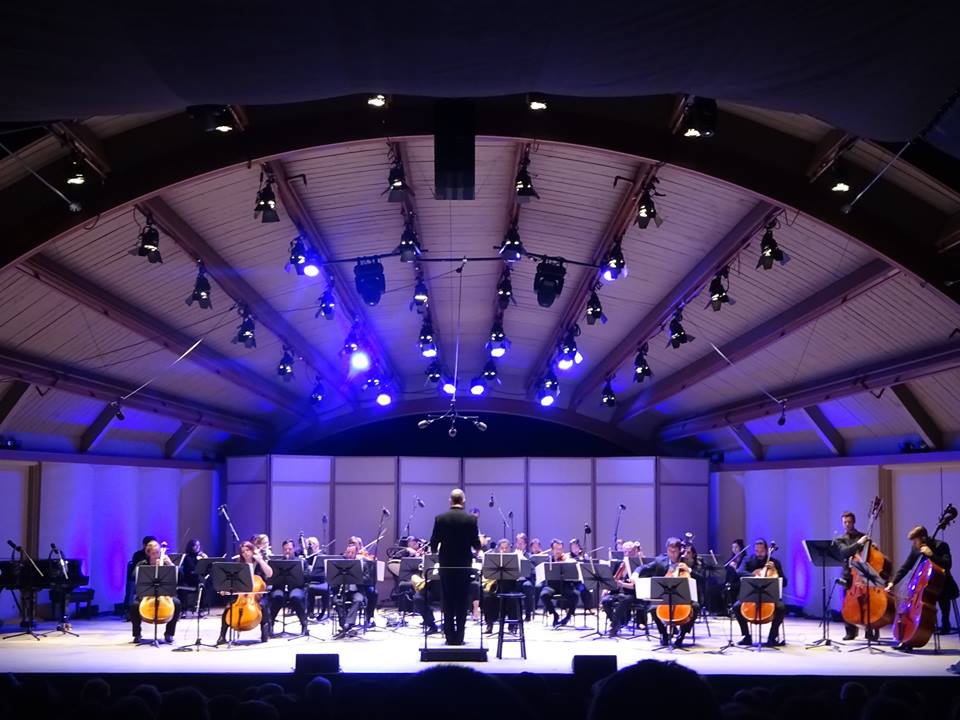
Photo by Bonnie Wright (used with permission).
The 69th Ojai Music Festival continued late Saturday night, June 13, 2015, with the West Coast premiere of Become River by John Luther Adams as performed by ICE and Renga and conducted by Steven Schick. The Libby Bowl was filled for the 10:30 PM starting time with an energetic crowd on hand to hear two pieces, capping off the third full day of the festival.
Become River begins with an almost inaudibly high, thin pitch from bowed percussion that gradually builds in volume. The violins join in, playing their highest notes and starting a repeating phrase that is doubled by light bell-like sounds. One can almost imagine a small rivulet forming in a high meadow, winding its way down hill joining with others as it heads toward the sea. The flutes enter, adding volume and body to the small stream of sound, and with the clarinet entrance there is a markedly substantial feel. The orchestration in this performance was larger than, say, a chamber group, but smaller than a standard symphony – each of the horn, string, woodwind and percussion sections were represented, but in modest proportions.
Each succeeding entrance added to the harmonic richness, and the sound grew in volume and density with the repeating phrases gathering momentum. The beat was straightforward and the tempo relaxed but purposeful. Midway through, a certain amount of syncopation could be heard in the phrasing and this effectively served to shape the texture of the sound so that it very much resembled a flowing river – always full of motion, running waves and swells. As the trumpets and low brass entered, a noticeable sense of power was added and by the time the lower strings were heard there was a full, majestic feeling in the sound that nicely evoked the image of a large river approaching the sea. There was never any sense of anger or menace in this strength, however. Typical of Adam’s treatment of nature, there was a sense of peacefulness and cordial calm, an appropriate reminder that we would do best to live in harmony with a welcoming earth. As the piece concluded – and it seemed all too short – there was enthusiastic applause from the audience as John Luther Adams, Steven Schick and the musicians took their bows. Along with Become Ocean, Become River is now the second in a series of milestone works by John Luther Adams on the relationship of nature to humanity.
The second piece of the evening was the iconic Appalachian Spring by Aaron Copland, commissioned in 1942 by Martha Graham as a ballet and subsequently arranged in 1945 as an orchestral suite. Most listeners are familiar with the muscular symphonic adaptation of this piece, but for this performance The International Contemporary Ensemble played the lesser known the chamber orchestra version consisting of a double string quartet, string bass, flute, clarinet, bassoon and piano. This proved to be a revelation – the themes, harmonies and delicate structures of this piece came through with an amazing transparency, precisely preserving all the subtle details that are often swallowed up in the full symphonic version. The playing could not have been better – the ensemble was very tight, carefully balanced and pitch perfect in the cool night air. The woodwinds especially stood out, carefully crafting the quiet motifs and playing together seamlessly. The Libby Bowl sound system contributed as well – all of the subtleties and nuances in the playing were faithfully preserved. Those who stayed late to listen to Appalachian Spring were rewarded with luminous performance and a beautiful new way to understand Copland’s classic of American music.
Kate Hatmaker, violin, also appeared with ICE on Appalachian Spring.
Review: WasteLAnd: Tactile Sound
Art Share LA in the heart of downtown Los Angeles was the site on Friday May 15, 2015 of Tactile Sound, a concert of new music featuring the wasteLAnd musicians, Trio Kobayashi and other assorted soloists and guests. A good size crowd filled the roomy spaces of the comfortable Art Share venue.
The first piece on the program was The Flypaper by Steven Kazuo Takasugi. The stage was populated by Elise Roy, flute, and Stephanie Aston, listed as a soprano, but who appeared holding a flute. Microphones were positioned very near the flutes and speakers were placed in front and behind the audience. A single recorded voice was heard coming from the speakers, and this consisted of stretches of disjointed speech in what sounded like a man speaking in German. The flutes were heard initially as rushing air, with no tones produced and the recorded voice faded away, seeming to recede to the back of the room. The valves of the flutes were heard opening and closing, still without any tone being produced – a technique that continued throughout the piece. This sound was amplified and the effect was similar to hearing the dripping of water in a leaky basement. The use of the flute as an amplified percussive instrument was unexpected, challenging the listener’s expectation – but this was exactly on target with the Tactile Sound theme. The voice returned, in English this time, as the clicks and pops increased there was an undercurrent of mysterious discomfort that stopped just short of threatening, providing the connection to title of the piece. The Flypaper is a remarkable combination of electronics and conventional instruments used in unconventional ways. Steven Kazuo Takasugi was in attendance and received a warm round of applause.
Invisibility by Liza Lim followed and this was a solo cello piece performed by Ashley Walters. For this piece Ms. Walters used a bow with the hair strands wrapped rope-like around the bow stick. This produced a lovely combination of warm cello sounds and sustained, yet scratchy tones that were often rough but never crude. The overall effect was one of complexity, a mix of the alien and the familiar and clearly ‘tactile’. There was a vague sense of anxiety running through the piece and this was heightened with the unorthodox bow. It sometimes seemed that more than one instrument was in the room; the playing always sounded assured and under control. Midway through Ms. Walters picked up a conventional bow and the sounds became noticeably smoother with more individual notes. This section contained perhaps a bit more dynamic range – very light at times, and much stronger at others, especially in the lower registers. There were some smooth and harmonious stretches here that provided a good contrast to the opening sections. Towards the end of the piece both bows were used – one in each hand – to produce an intriguing mix of sounds that was at once both rough and soothing. Any remaining doubts about the virtuosity of Ms. Walters were dispelled by the enthusiastic applause that followed. Invisibility, like The Flypaper before it, is a piece that challenges the expectations of the listener in new and unusual ways.
The world premiere of eiszeiten by Richard Barrett was next, and this featured the playing of Trio Kobayashi – horn, trombone and tuba. The piece began with the sound of air rushing through the horns and tongued so as to create a kind of pinging sound. This was picked up and amplified through the speakers and the effect was like hearing the cold wind blowing. These sounds eventually morphed into tones from each horn, forming sustained chords that were somewhat high in pitch and dissonant at times, producing an otherworldly feel. The harmonies here were indefinably unorthodox – reminiscent of train horns that are close in pitch, and not quite forming a conventional interval. Powerful tutti chords were heard and these became more traditional in character as they gained in strength. The electronics emitted a deep bass drone and the players joined at approximately the same pitch with some zero-beating becoming audible at times. The brass then began to play passages of moving notes and this brought a sense of movement to the texture. The electronics replied with a loud dissonant chord – in full 1950s Sci-Fi mode – and the brass added a syncopated line that enhanced the alien feel of this section. The electronic sounds suddenly ceased and the brass trio played the piece to a close. Eiszeiten, which translates to Ice Ages, certainly evokes a cold, alien landscape and the integration of the electronics with the playing of Trio Kobayashi was precise and effective.
CYMBALMUSIC II: Centerflow/Trails II by Eleanor Hovda followed, performed by Justin DeHart. This is the second piece of a five piece set, and was inspired by the rigors of cross country skiing as experienced by the composer. The graphical score, in fact, includes a series of marks and squiggles that resemble ski tracks. For this performance two cymbals were mounted on a single pedestal. The audience was asked to hum or sing a sustained tone as heard from the cymbals as they were bowed by DeHart. The sound produced by the bowing was generally high in pitch but full of overtones and this nicely suggested a cold, sunny day in a white landscape, with a stinging headwind blowing. The vertical motion of the bowing across the edge of the cymbals was itself was reminiscent of ski poles pumping up and down as the skier moved through a frozen landscape. The humming from the audience was mostly tentative, but added a smooth timbre and seemed to amplify the sounds coming from the cymbals. As the piece progressed the tempo slowed and the sound felt more labored, as if the skier was becoming fatigued. Towards the end the volume also decreased until there was just a low humming heard from the audience as the piece concluded. CYMBALMUSIC II: Centerflow/Trails II is an artful work that produces the maximum effect from minimal musical forces yet delivers a vivid imagery to the mind of the listener.
After the intermission, Trio Kobayashi returned to play Tones and Noise II by Dustin Donahue. This began with a low roaring from the stage speakers, sounding very much like a rocket exhaust at close range. The horns joined in, playing syncopated notes that provided an interesting contrast to the noise texture. The roaring became intermittent and the brass passages more animated as if we were in the presence of a large beast or mechanism. The roaring noise was renewed and perceived as coming from different directions through the speakers on both sides of the audience. The brass parts became louder and longer, as if combining with and matching the roar. The feeling was that of being inside a rocket in space, hearing the blast of the engines and the sounds of mechanical automata as portrayed by the brass. Tones and Noise II is an intriguing piece that manages to work effectively on the imagination by using amplified noise and simple brass figures.
The final piece of the concert was the world premiere of Saxony by James Tenney in a version for brass quintet. James Tenney, an influential West Coast composer and educator, died in 2006, but this piece from among his unperformed works was selected for premiere at this concert. Trio Kobayashi was joined by two trumpet players – Jonah Levy and Aaron Smith – to complete the ensemble. Saxony opened with a low, sustained tone in the tuba, matched by the electronics coming through the speakers. At length the trombone entered, doubling the tuba and noticeably changing the timbre of the chord. The trombone moved up what sounded like a third and the horn entered changing the timbre yet again. All the tones were sustained and this anchoring of the sound by the low brass seemed almost Wagnarian – certainly German – and in keeping with title. The piece proceeded in this way, the trumpets adding their parts, piling pitches on top of pitches within the chord, all combining to create a powerful sound. The intonation here was critical and the ensemble held together admirably. When all the players were engaged, a series of trills in each horn added pleasing new colors and shortly after, each horn began to play a series of short phrases that added an agreeable variety to the texture. The piece then reversed – the tones tapering downward and the trumpets going tacet. The sound became lower and more cohesive, producing some lovely chords. When only the trombone, tuba and electronics remained, the sound became lush and warm. The piece concluded by slow diminuendo with the remaining horns laying out until only the tuba held the bottom note. When the sound finally ceased the audience remained silent for a good 15 seconds, a tribute perhaps more notable than the enthusiastic applause which followed. Saxony is masterful work that extracts considerable emotional impact from its minimal structure and pitch palette.
Trio Kobayashi is:
Alan Fogle – Horn
Matt Barbier – Trombone
Luke Storm – Tuba
Review: Casey Anderson and Friends in Concert
The wulf in downtown Los Angeles was the site for a concert of the experimental music of composer Casey Anderson. A nice Sunday night crowd turned out on April 19, 2015 to hear an evening of new music at the leading edge of the performance vanguard.
The first piece was TALK RADIO (an opera), 2011 and for this eight performers were equipped with portable radios and headphones. Their instructions were to continuously tune through the dial – independently and without coordination – and repeat what was heard when a radio station came into hearing. Random phrases, sports scores, jingles and snatches of music were heard by the audience as spoken or sung by the performers. Static was also heard on occasion, as represented by a spoken rushing sound. Phrases such as “Line of credit…”, “Quite heavy still on the northbound 5…” or “Right out of the blocks, you get healthy…” were spoken. These came randomly as they were heard in the headphones and the phrases were sometimes repeated. Sometimes a tone heard on the radio – perhaps as part of a song – was sung and held by a performer as it was encountered on the radio dial. Here is a short video of a part of this piece that was made during rehearsal:
At times all were silent, and at other times two or more performers stepped forward as ‘soloists’. There were tutti sections when everyone was singing or repeating snatches of advertisements, editorials or traffic reports, and these were quite lively. Sometimes the fragments were quite poignant as when “Oh I’m in pain” was heard, along with pieces of a radio preacher’s sermon. TALK RADIO is perfectly named because what the audience hears are chunks of radio prose and music, but drained of all the production values and hype. It is as if someone you know is telling you about the latest news without the breathless, hyperbolic style we are accustomed to hearing when we listen to the radio. TALK RADIO is an engaging experiment in perception and translation and one that is both a random and unique experience.
false positives (2015) followed and this involved four drums fitted with microphones and amplification. Tuning forks of various frequencies were struck simultaneously, and the base of each applied to a drum head. The amplification immediately picked up the pitches and projected a strong, pure tone. This was quite startling at first; the striking of the forks had a small, distant sound – like silverware dropped on the floor in another room. But once applied to the drum heads the sound took on a boldness as the various frequencies mixed together, and then slowly died away. The process was repeated, with different sets of tuning forks, and this consistently produced a clean, but somewhat alien feel. The sounds produced were impressive nonetheless, and one could sense that the energy was being concentrated in a set of single frequencies. false positives was an interesting experiment in the perception of a small pure sound that is suddenly amplified.
After the intermission SLIPS (2015) began by six performers who recite “…a text distorted via loosely synchronized extensions to vowels or sibilants.” This took the form of speaking in unison the word taken from an image-filled story while every few seconds a tone was sung and held for a few moments by a single reader. The pace of the speaking was fairly rapid and this often carried the suggestion of a rhythm or cadence. As the story progressed a picture begins to form in your mind and when a pitch was sung by one of the performers your brain quickly associates an emotional color to that text, separate and apart from the image created by the words. It was as if the tone was shorthand for the longer effort of constructing a word image from the story and connecting it with a distinct feeling. The text seemed to veer off at odd times, restarting the process of assembling a mental image – and then a tone would be heard that produced an immediate emotional reaction. This contrast in the timing of the contending feelings provoked by two compartments of the brain are a fascinating study in personal perception and SLIPS would seem to have much to teach us about the relationship between lyrics and music.
The final piece of the evening was KARAOKE (2015) and for this five performers with headphones listened to the same album and individually created a sort of “quasi-private accompaniment.“ The audience heard only what was produced by the performers and this took the form of some humming, singing and whistling along with various kinds of drumming, tapping and rhythm-making, as well as the occasional piano run or saxophone riff. None of this was intentionally coordinated, each performer being fairly well isolated by headphones from the sounds produced by the others. Even so, the combined sounds heard by the audience often achieved a noticeable groove. This had an authentically primal sound, like something that might be heard around a camp fire fifty thousand years ago. As the album played through its various tracks you could sense a regrouping by the performers and it took a few minutes for the aggregate sound to come back into focus, much like a street-corner quartet feeling for tune. KARAOKE is an engaging piece that produces music almost as if by telepathy and makes an interesting point about the necessity of an organizational performance structure.
The performers in this concert were Casey Anderson, Jon Armstrong, Rick Bahto, Brendan Carn, Josh Gerowitz, Morgan Gerstmar, Todd Lerew, Liam Mooney, Stephanie Smith, Christine Tavolacci, Colin Wambsgans, Joe Westerlund, Michael Winter, and Andrew Young.
The next concert at the wulf will be May 5, 2015 at 8:00 PM featuring the music of Michael Pisaro and Graham Lambkin.
Review: Colin Wambsgans at the wulf
The wulf in downtown Los Angeles was the venue for a performance of the compositions of Colin Wambsgans on Saturday night, March 21, 2015. The cozy spaces of the Wulf filled up with a friendly crowd ready to experience experimental music and field recordings in a concert titled wherever you are, there you’re at.
The first section of the concert consisted of three pieces described in the program notes as “text scores, mostly in unison.” The structure of these was similar – a stopwatch is used to set ten second intervals, followed by the start of a phrase with all the players in unison. For the first piece, 55 Things (2013), each of the various players to continued to play independently for the number of times indicated in the text score. The instrumentation was varied and diverse, consisting of everything from a soprano saxophone, an accordion, a number of toy percussion items, a large rat trap and what seemed to be the contents of several kitchen drawers.
Each passage began in unison with a wonderful roar of sound that gradually lessened and changed in timbre and texture as the various players finished the sequence of their assigned soundings – all in the span of just a few seconds. The approximately equal mixture of traditional acoustic instruments and found objects produced a unique texture and feel to each passage as it was played. Sometimes the effect was alarming and chaotic and at other times more familiar and musical. Every ten seconds the listener was presented with new and instantaneous decisions about how to deal with the timbre, textures and emotions that were being broadcast. Interestingly for the listener, the brain would often impose a musical context over the combination of sounds that were heard. 55 Things is an intriguing piece that challenges the listener’s instinctive discrimination between sound and music, ultimately sharpening and extending the limits of our aural perceptions.
The second piece on the program was Five* Minutes for Percussion Quartet (2014), and this consisted of a more traditional array of drums, gongs, triangles and wood blocks. The stopwatch was again employed to set the ten second intervals, but just prior to the unison entrances one of the players would conduct a tempo for the others to follow. In this way a more familiar musical sound and pulse was produced and this acted to enhance the listener’s organization of the sound into a musical perception. The phrases lasted only a few seconds, but they had a strong feel of familiarity, like hearing a fragment of something you knew, but couldn’t quite identify. The use of the more familiar instruments and gestures in Five* Minutes for Percussion Quartet made for a somewhat more accessible entry into Wambsgans methods.
Soft Targets (2015) was next and this was scored for piano, guitar and several percussion pieces, all led by a violinist who kept time for the ten second intervals. As before, the players entered in unison but for this piece there was just a single note played or struck. When the piano was included the chord that was sounded by the ensemble has a strong musical feel – otherwise the percussion, guitar and violin – playing her notes pizzicato – tended to produce a sharp, short chord that dissipated somewhat more rapidly than would have been ideal given the acoustics of the room. Even so, there were detectable feelings of tension at times and a more optimistic sound at other times. As the piece progressed the pitches gradually rose and some of the chords took on a questioning feel, while others seemed to be offering an answer. The chords could be delicate and ethereal, but also sharp and edgy. Soft Targets was perhaps the more structured and intentional of the works in this concert, but the short duration of each chord made for challenging listening and inevitably the outside noise that floated in occasionally obscured the hearing.
Another variant of Wambsgans composition technique was heard last year at Boston Garden employing an ensemble of horns and strings that produced chords of sustained – and powerful – tones. This arrangement delivered a somewhat less ambiguous sound than some of the more subtle instances in this concert at the Wulf. The three variations heard on this occasion were all interesting explorations of an experimental style that offers the observant listener much to examine.
After an intermission an extended field recording was heard titled wherever you are, there you’re at (2014-2015). This began with the sound of a soft rain falling, water running in a downspout and a whistling tea kettle – as if this was the beginning of the day. Presently outside sounds were heard – the voices of neighborhood kids, a jet in the distance and more street sounds. All of this gave the impression of embarking on some sort of journey and more clues came in the form of vehicle sounds, train station announcements and a busking clarinet player. The audio-only track tends to focus the concentration of the listener, and the game of trying to determine the destination continued as the piece progressed. There was a stretch of hearing a distant trumpet player practicing and some animated street conversation in a foreign language. At the end of the recording, the lively street conversations were accompanied by the chirping of birds, conjuring an affectionate equivalence. wherever you are, there you’re at invites the audience to listen carefully in order to assess the location and intentions of the unseen traveler while enjoying the rich visual detail constructed thereby in the mind’s eye.
The performers in this concert were:
Casey Anderson
Justin Asher
Corey Fogel
Liam Mooney
Chris Porter
Stephanie Smith
Michael Winter
Todd Rue
The next event at the wulf will be on March 29, 2015 featuring the music of Powerdove and Ulrich Krieger.
Review: Cold Blue Music + Formalist Quartet at Monk Space
Monk Space, in the Koreatown district of Los Angeles was the venue for a concert titled Crazy Quilt, string music from the Cold Blue recording label as performed by the Formalist Quartet. A nice midweek crowd turned out on March 10, 2015 – Crazy Quilt being part of the monthly Tuesdays@Monkspace series of new music concerts.

The Formalist Quartet
Hymn of Change (2010) by David Rosenboom was first, in an arrangement by Andrew Tholl, one of the violinists in the Formalist Quartet. This piece derives from an earlier work by Rosenboom, as he writes in the program notes: “In my 1998 work for piano, Bell Solaris- the Sun Rings Like a Bell, initiating waves of influence that traverse, shape, and create space, time and life – twelve movements emerged from subtle and grand transformations of the Hymn of Change, which I had written earlier in 1992. Some years later, after hearing Bell, Andrew Tholl was inspired to arrange the Hymn, a kind of slow, gospel waltz, for string quartet.” The result of Andrew’s efforts is a warm, traditional sound with full four part harmony and good balance that perfectly recalls the sunny days of late-19th century Americana. Although not a long piece, the careful playing of the Formalist Quartet and accommodating acoustics of Monk Space combined to bring Hymn of Change into a vivid realization that brought complete tonal satisfaction.
Music for Airport Furniture (2011) by Stephen Whittington was next, and this was a US premiere. An Australian musician with a long history of involvement with contemporary composers, Whittington gave the first performances in Australia of music by Christian Wolff, Terry Riley, James Tenney, Peter Garland, Alan Hovhaness and Morton Feldman – among many others. Whittington’s extensive travels were the inspiration for Music for Airport Furniture – which owes far more to Erik Satie than to Brian Eno. This is not music to fill public spaces but rather tailored for the interior of the human heart. Whittington writes: “I was interested in the airport departure lounge as an arena for human emotions – boredom, apprehension, hope, despair, loneliness, the tenderness of farewells – all taking place within a bland, often desolate space.”
Music for Airport Furniture consists of a series of long sustained phrases, lush and warm, broken only by the occasional pizzicato arpeggio in the cello. The sweet sadness of farewell is slowly released with a distant, introspective feel. The string quartet is the perfect ensemble for this music. The delicate texture was nicely realized by the Formalist Quartet who kept the long, quiet passages interesting by infusing just the right amount of energy while at the same time carefully controlling the dynamics. The brick wall acoustics of Monk Space allowed the intimate and heartfelt sensibility of this piece to reach all parts of the audience. Music for Airport Furniture slowly unpacks all the emotions of the lonely traveler waiting for an airline boarding call.
After an intermission the concert concluded with a world premiere – String Quartet No. 4 Crazy Quilt (2014), by Peter Garland. Crazy Quilt is based on an earlier work for solo cello – Out of the Blue – written the year before, which consisted of a rising, then descending arc of 44 pitches. The other instruments of a string quartet were then added to this foundation to increase the timbrel possibilities. As Garland writes, “I chose different basic time units: with the cello maintaining its 60-second unit, the viola uses a 75 second unit, violin 2 uses a 90 second unit; and violin 1 uses two different units – first a 45 second one, then shifting to a 30 second unit, and finally going back to 45 seconds. The common denominator for all these is that they add up evenly to 45 minutes (2700 seconds). I.e. what starts together, ends together…” For this performance page turners were employed as the players were continuously engaged in sounding the long, sustained tones called for in the score.
The beginning of Crazy Quilt is a quiet, sustained chord in the lower registers of each instrument. The bowing by the players was, of necessity, achingly slow – but the sound produced was warm and full. As the time units rolled by, the chord would change slightly, – generally rising in pitch – but very slowly and deliberately. Each change of tone by a player would reveal an entirely new feeling in the sound, sometimes adding tension or anxiety and sometimes resolving into mellowness and warmth. There was no beat per se; the players had to concentrate and be in good communication as each was working to a different time unit. Overall the effect was very engaging – like watching a slow-motion kaleidoscope. In the lower registers the feelings were mostly smooth and reassuring, but as the pitches increased the more stressful and anxious sensations predominated. At the very top of the arc the violins soared above the rest of the ensemble – sometimes heroically and sometimes with great angst – but always bringing another interesting variation to the sound. As the piece floated gently downward in pitch, the chords seemed to become gradually more consonant and consoling. The familiarity and harmonic cohesion in the middle registers added to the feeling of solace, and by the conclusion of this piece there was a comforting sense of return.
Crazy Quilt is an ambitious work, attempting as it does, to conjure so many different colors and feelings from the sound. It is also a difficult piece to play given the different time units and sustained pitches required – with no conventional tempo or harmonic progressions to follow. Despite these challenges, the Formalist Quartet brought this piece fully alive so that the vision of Peter Garland was fully articulated.
The Formalist Quartet is:
Andrew Tholl, violin
Mark Menzies, violin/viola
Andrew McIntosh, violin/viola
Ashley Walters, cello
The next concert at presented by Tuesdays at Monk Space will be on Saturday, March 21, 2015 at 8:00 PM at Villa Aurora, featuring The Varied Trio (Yuri Inoo, Aron Kallay, and Shalini Vijayan). Music of Lou Harrison, Bill Alves and others will be performed.
Review: Doron Sadja and Byron Westbrook at the wulf
On Saturday, February 7, 2015 the wulf presented works by Byron Westbrook and Doron Sadja. The friendly confines of the wulf were nicely filled with a crowd that heard an evening of field recordings from Westbrook and selections from Doron Sadja’s electronic work, In Slow Motions.
According to the program notes, the recordings of Brooklyn-based Byron Westbrook explore “…listening, space, perception and awareness, often pursuing routes with social engagement. His electronic sound interventions play with dynamics of perception of space, sometimes as multi-channel sound performances or as installation work using video or lighting.”
The first group of recordings presented were monophonic and captured a single happening outdoors with the microphone acting as a sort of aural camera. Walking a path near a power plant produced a loud 60 cycle hum that alternately increased in volume or faded into the background. There was the low roar of machinery at times, and also the sound of people talking. When the hum predominated there was the opportunity to focus on the pitch itself – removed from its visual power plant context – creating a sort of La Monte Young moment. In another recording at the same place, the soft rumbling of machinery contrasted with the loud chirping of a flock of birds and this served to even the balance of nature in the listeners ear for what must have been an overwhelmingly industrial location.
In another recording, a speaker issuing white noise was placed near the microphone and this was heard along with crickets and other natural background sounds. As the white noise came into the hearing it took on an ambiguous character in the listener’s mind. Sounding at times like a waterfall or maybe a hissing steam pipe, the listener had to decide if it was part of the natural environment or not.
A recording of a violin being played under a freeway produced another interesting effect – as the violin predominated, the familiar image of a musical instrument came to mind. When the freeway noise was dominant, it naturally produced an image of cars passing overhead. But as these sounds cross-faded in and out there were times when the listener conflated the sounds: the freeway was music and the violin part of the traffic. This is a technique that has been effectively employed by John Luther Adams in his outdoor works songbirdsongs and Inuksuit – the periods of silence in these pieces allow the natural environment to become part of the music.
Other Westbrook recordings explored spatial relationships by incorporating two microphones. One involved a power transformer and street noise, another a tambura simulator in two locations. There was also a recording of natural ambient sounds – and the ubiquitous traffic noise – from a local canyon. Another recording had four guitars playing sustained pitches, and as the piece progressed the listener heard, variously, musical harmonies, simple drone hums and somewhat more mysterious, alien sounds. Perhaps the most striking field recording that was presented was a viola playing on a roof top near an exhaust fan. The viola played a sustained note at about the same pitch as the fan – and as the two sounds faded in and out it became difficult to tell where one started and the other left off. Lacking any visual clues, this piece offered elegant evidence of how just much the listener’s brain improvises when descriptive details are missing.
The field recordings presented by Byron Westbrook invite the listener to examine what is being heard, and to question – or at least try to understand – the factors at work influencing our aural perceptions.

Doron Sadja followed with his electronic composition In Slow Motions and this was realized by a table full of computers, synthesizers and mixers. A projector was included that added a video display to the mix. The piece began with a series of deep rumblings that were effectively amplified by the sound system. This was a low, primal roar – like being inside a volcano and hearing massive tectonic stresses groaning deep within the earth. At one point there was an explosive sound that made everyone jump in their seat and this was followed by even more powerful rumbles – the kind you feel more than hear. The combination of the darkness, the powerful sound system and synthesized booming were just on the edge of producing real anxiety.
As the piece progressed the sounds became somewhat more industrial – metallic grinding and something that might be a train horn. These remained very strong but slowly evolved into something more mournful. The projections on the wall were not controlled directly by the sounds, but consisted of a series of precise patterns and colors that gave a welcome sense of order and purpose. As the piece progressed the sounds evolved from earthly and organic to more industrial and civilized. There were sirens, the squeal of brakes, a series of clicks and taps that all pointed towards a more technical environment. Towards the end there were musical sounds along with a sunny yellow projection that seemed to hint at optimism.
In Slow Motions was improvised by Sadja as it unfolded – there was no programming element to the sequence of sounds and projections. There did seem be an arc to it, from an earthy, violent beginning towards a post-civilized future. In Slow Motions is a power-filled electronic realization combining sound and image.
The next activity at the wulf will be Saturday, February 14 at 8:00 PM and will feature
Lisa Truttmann and Guido Spannocchi who will present Elsewhere Lands, a multi-layered media project about theme parks and their audio-visual abstractions.
On February 28 at 8:00 PM Colin Wambsgans will appear.
Review: Lyris Quartet in Concert
Saturday, November 15, 2014 found the Lyris Quartet at the Jack Rutberg Fine Arts Gallery on North La Brea for a Music and Conversations concert. Surrounded by the art of Bruce Richards and a selection of Casa Torelli wines, about 75 people turned out to hear the music of Arvo Part, Jane Brockman – who also produced the concert – and a Beethoven string quartet. Eric Jacobs, playing clarinet and bass clarinet, joined the Lyris Quartet for the first two pieces.
 The opening piece of the concert was Es Sang vor langen Jahren, by Arvo Pärt. This is scored for strings and countertenor but for this performance Eric Jacobs played the voice part on bass clarinet from offstage. This was an effective substitution and gave the piece a folk-like character that was at once charming and mysterious. The opening stringendo in the strings was offset by a slow, solemn melody from the bass clarinet. These passages were echoed in the strings from time to time and a pedal tone in the cello was most effective in setting an introspective mood. Variations added some drama, especially in the lower strings, that also included some spare – but lovely – harmonies, and a peaceful feel. The playing by the Lyris Quartet was right on target, and the strong clear tone of the bass clarinet was especially soulful. Es Sang vor langen Jahren was nicely played throughout and the higher registers of the bass clarinet proved to be a good choice for realizing the vocal line.
Scenes from Lemuria by Jane Brockman followed and in her remarks Ms. Brockman disclosed that her training was in New York as part of the academic “uptown” scene of the late 20th century. Writing what she irreverently referred to as ‘root canal music’, the move to Los Angeles around the year 2000 had, she explained, mellowed her sound somewhat. Scenes from Lemuria began with a high, arcing clarinet line by Eric Jacobs that was soon joined by a series of rapid string passages that gave a bustling feeling of movement and motion. The clarinet and strings went back and forth and the contrasting dynamics were especially effective. Although animated and bright, this piece conveys an optimistic feel that could be described as mellow. The interior harmonies were nicely balanced and full, giving a warm feeling that often morphed into a more exotic sound. Although complex and lively at times, Scenes from Lemuria is ultimately an inviting and welcoming experience. The playing was accurate and precise, a credit to both the Lyris Quartet and Eric Jacobs who had to cover a lot of material.
The final piece in the concert was Beethoven’s String Quartet No. 13, Op. 130 in Bb major. This is one of Beethoven’s later works, composed when he was fully deaf. It consists of six movements instead of the usual four, and there are two possible final movements. The playing in the opening movement was solid with good precision in the faster sections and also had a smooth, romantic feel that was, at times, sunny and optimistic. In the second movement the fast passages and close harmonies were navigated with the necessary skill and care – there was a detectible wit and playfulness that came through nicely. The third movement was slower and more deliberate with the melody line in the violin rising agreeably to the top of the texture with good balance below. The dance-like fourth movement contained some complex rhythms and a melody that was passed effortlessly between the players while the more empathetic and slower tempos highlighted the pathos present in the fifth movement.
For this performance the Lyris Quartet elected to play the original Grosse Fugue for the last movement. The first playing of this movement generated such an uproar that Beethoven was convinced by his publisher to write an alternate version. The Grosse Fugue has a lot of moving parts – four subjects in all – and a big, almost harsh sound. There is a complex and frenetic feel to this and the Lyris Quartet looked to be intently focused. This is challenging music with meandering and interweaving passages that arguably might have prefigured early 20th century music. From our vantage point today the Grosse Fugue is certainly very forward looking for its time.
The next Music and Conversations concert will take place in early 2015.
Ojai Festival 2012 stuff
On the off chance that you hadn’t heard yet, this past weekend’s Ojai Festival was a resounding success. Here’s some cool stuff about it:
Photos from John Luther Adam’s Inuksuit
Interview with Steve Schick on LAist
If you find anything else cool posted about the festival, please leave it in the comments. Thanks!
Review: Los Angeles Chamber Orchestra plays Golijov, Bermel
LACO’s concert this past Saturday night at the Alex Theatre featuring West Coast premieres from composer-in-residence Derek Bermel and Argentine megastar (in some circles) Osvaldo Golijov was a serious kicker of a season opener.
Maestro Jeffrey Kahane, who is celebrating his 15th year as LACO’s music director, opened the show with a surprisingly energized and bold sounding Overture from The Magic Flute. For a piece we’ve all heard a million times (and I wasn’t particularly excited to hear again), Jeff and the LACO cats breathed some serious new life into it.
I had brought a few friends who dig modernism but find most traditional classical music really dull, and they both said that it might have been the best performed piece of the night, and that they were totally into it. LACO 1, 99% of period instrument ensembles 0.
Golijov’s Sidereus was probably the highlight of the evening, although it didn’t overshadow Bermel’s Ritornello for a moment. The Golijov managed a bit of a post-minimalist, almost Inception-soundtrack-Hans Zimmer sound at times, with descending seventh chord arpeggios in the upper strings, but modal lines in the winds and constantly changing textures kept the piece interesting. Some particularly exciting downbeat-heavy brass polyrhythms toward the climax really carried the piece across the line from “well that was cool” to “where can I get a recording?”
Possibly the most impressive thing about it was Kahane’s handling of the rhythm. I’ve always thought of him as a colorist. He’s very sensitive to balance, and lets everything breathe, but I couldn’t personally imagine enjoying him doing, say, Rite of Spring. After this past Saturday I’d certainly like to hear it.
The Bermel, with Wiek Hijmans on electric guitar, may have been the stylistic high point of the evening. Most electric guitar concertos fail miserably, in that composers use sounds that are so idiomatic of the electric guitar – bent strings, chunky power chords, etc. – that the pieces sound totally forced, almost like a show of “look at me, I know how to rock too!” Such was not the case with Bermel’s Ritornello. If anything, he managed to find the perfect blend between the guitar and the ensemble, with the guitar’s broken triplet pattern being perfectly backed by the perfectly tonal harmonies outlined in the strings.
Hijmans is an excellent improviser – downright inspiring – and Bermel certainly gave him room to play. In what may have been good taste, Hijmans kept his improvisations short and to the point. I would have enjoyed it a bit more if he had extended his solo sections a bit further, but that was in no way detrimental to enjoying the piece.
The second half, Beethoven’s 4th piano concerto, saw Kahane return to his colorist self. There’s no doubt about his abilities as a virtuosic pianist, and it is great to see him conduct from the keyboard, but I felt that the performance lacked the punch and boldness it really needed to carry it over the edge. The audience dug it though, and called him back for an extended encore. Mark Swed over at the LA times seemed to think it rocked a little harder than I did, so read his review too.
LACO’s got a few cool concerts coming up. The next one we’ll be covering here is December 10th, which will feature some music from Brit boy-genius Thomas Adès. If the season opener is any indication of things to come, I’m excited already.